
Researchers at Seoul National University of Science and Technology (SEOULTECH) reported an AI system for SSD failure prediction designed to stay reliable even when the training data includes incorrect failure labels, a common issue in large-scale data centers where fault attribution can be messy at the rack level.
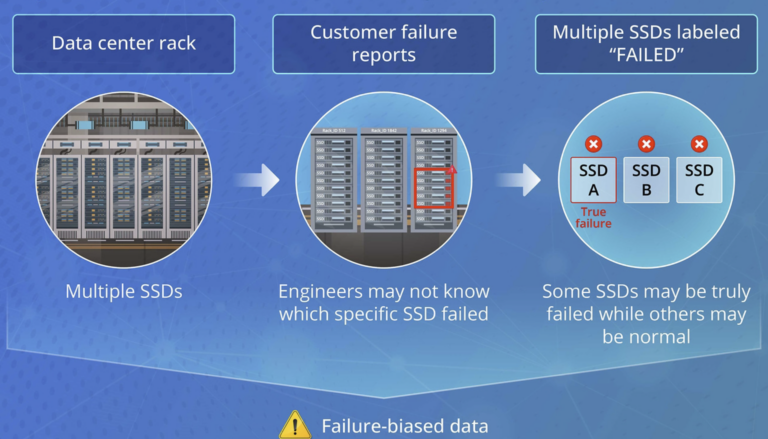
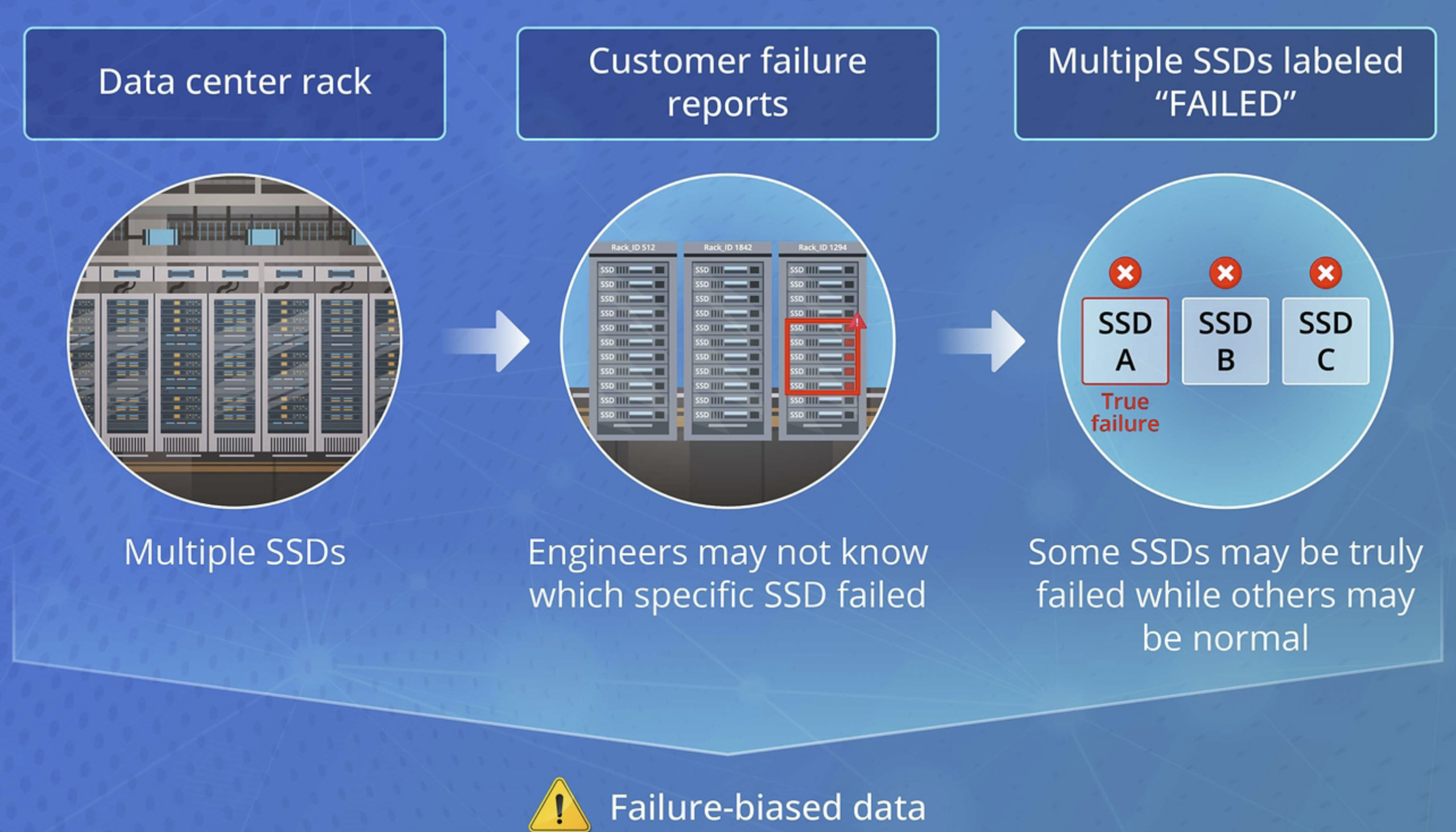
The work targets a practical problem with S.M.A.R.T. (Self-Monitoring, Analysis and Reporting Technology) logs: while SSD telemetry can support machine-learning-based failure prediction, the “ground truth” labels used for training can be wrong when operators can’t quickly isolate the exact failed drive after an abnormal event. In that situation, multiple SSDs in the same rack may be reported as failed, which can contaminate training sets with healthy drives labeled as failures and degrade conventional models.
The team, led by Assistant Professor Jaewoong Shim of SEOULTECH’s Department of Data Science, used Multiple Instance Learning (MIL) to learn from those imperfect reports. SSDs reported from the same rack on the same date were grouped into “failure bags,” allowing the model to train on group-level failure information while still producing a per-drive failure-risk estimate.
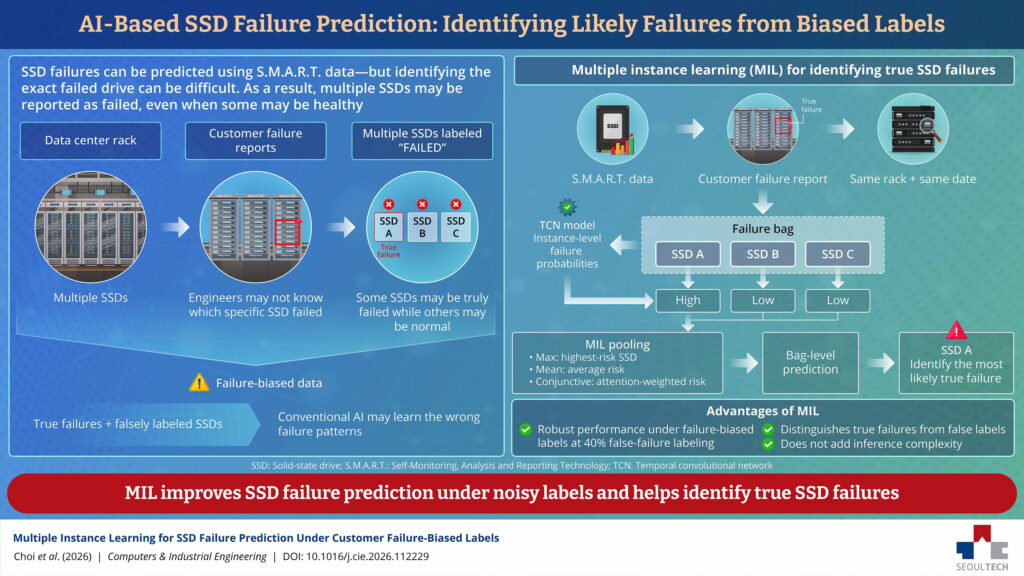
A temporal convolutional network (TCN) analyzed each SSD’s S.M.A.R.T. data sequence over time to produce individual risk predictions. During training, those per-SSD predictions were aggregated at the bag level; during inference, the system outputs individual SSD risk scores.
The researchers evaluated the approach using F1 score (0 to 1). Under a simulated 0% false-failure condition, a conventional model achieved an F1 score of 0.731. When the training labels were simulated to include a 40% false-failure rate, that model’s F1 fell to 0.261. Under the same 40% condition, the mean-pooling variant of the MIL approach achieved an F1 score of 0.717.
For operators, the blunt takeaway is that label noise can wreck an SSD predictor fast, and approaches that explicitly assume imperfect labels can hold up better when field reporting is imprecise. In the study’s results, the model also separated genuine failures from healthy SSDs incorrectly reported as failed, ranking true failures at an average of 1.6 versus 3.5 for incorrectly reported failures.
“Industrial AI has to work with the data that are actually available in the real world, and those data are not always perfectly labeled,” Shim said. “Our goal was to develop a way for AI to learn from these imperfect failure reports without assuming that every reported SSD failure is correct.”
The study was conducted with researchers from Samsung Electronics using real-world SSD data from an Alibaba Cloud data center. It was made available online July 6, 2026, and published in Volume 219 of Computers & Industrial Engineering on September 1, 2026. The paper is titled “Multiple Instance Learning for SSD Failure Prediction Under Customer Failure-Biased Labels” (DOI: 10.1016/j.cie.2026.112229).