
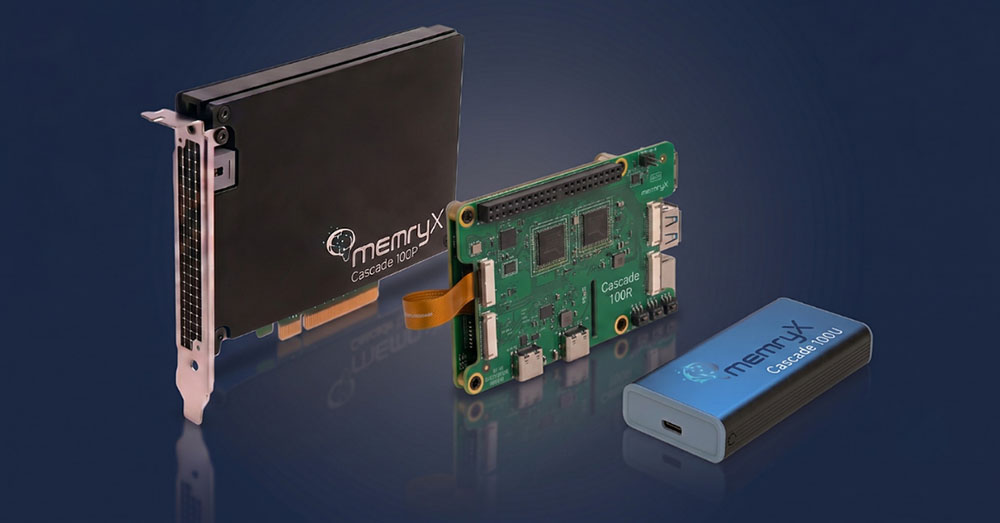
MemryX expanded its Cascade Platform lineup with three new MX3-based accelerators aimed at scaling power-efficient edge AI from embedded targets up through high-density edge servers. The additions include a PCIe card for server deployments, a USB Type-C accelerator for existing systems, and a Raspberry Pi HAT+ for the Pi ecosystem.
The new top-end module is the MemryX Cascade 100P PCIe Accelerator, designed for “high-density edge server deployments” and multi-camera AI workloads. It’s built on a 16-chip array of MX3 processors and is positioned for parallel inference on hundreds of real-time video streams. MemryX describes the card as a single-slot, passively cooled form factor intended to fit standard server environments without adding thermal complexity.
For teams that need to add acceleration without redesigning a system, the Cascade 100U USB Accelerator connects over USB Type-C. The device integrates two MX3 accelerators and is targeted at evaluation, prototyping, and deployment of AI vision applications in existing hardware platforms.
At the low-power end, MemryX introduced the Cascade 100R Raspberry Pi HAT+. The HAT is built around two MX3 processors connected via PCIe, and it can be cascaded to support larger deployments. MemryX called out robotics, machine vision, education, and low-power industrial use cases for the Raspberry Pi form factor.
All three products share a common software path through MemryX Developer Hub, which the company says provides a single environment for compiling and deploying AI models across the MX3 product family.
Edge AI deployments often fail for mundane reasons: power budgets, thermals, and integration time. A passive, single-slot PCIe card and a USB Type-C accelerator are practical form factors for operators trying to bring inference closer to cameras and sensors without turning every rollout into a platform redesign.
“AI doesn’t have a model problem anymore, it has a deployment problem,” said Ross Jatou, CEO of MemryX. “Whether developers and system builders are prototyping on Raspberry Pi, adding AI acceleration to existing systems through USB, or deploying hundreds of video streams on edge servers, they need a common architecture that scales seamlessly and delivers performance without the power and memory penalties of traditional approaches.”
Source: MemryX