
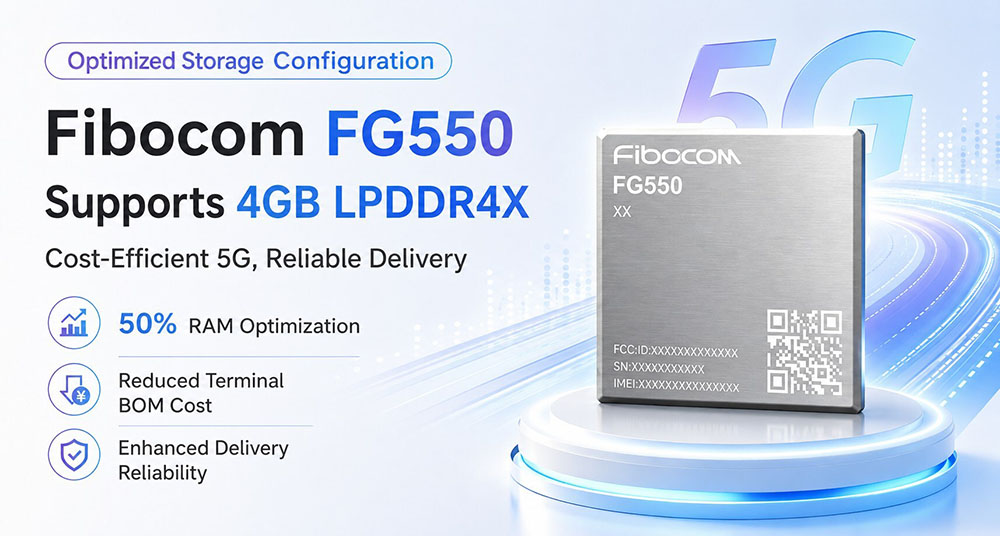
Fibocom introduced a storage-optimized version of its FG550-EAU 5G module at MWC Shanghai 2026, cutting the module’s LPDDR4x memory configuration from 8 Gb to 4 Gb. The change targets lower cost and more predictable supply for 5G device builds while keeping the module’s existing business functions and customer-specific customization options.
The Fibocom FG550-EAU is based on the Samsung Exynos Modem platform. Fibocom describes the move as a 50% reduction in RAM capacity, shifting from LPDDR4x 8 Gb to LPDDR4x 4 Gb. The company ties the optimization to memory price volatility and availability constraints, positioning the 4 Gb configuration for cost-efficient 5G terminals and “reliable delivery” in mass production.
For engineers building 5G gateways, mobile broadband devices, or embedded connectivity into industrial hardware, memory isn’t just a line item—it’s also a supply-chain dependency that can gate builds. Dropping DRAM density can be a straightforward way to reduce BOM exposure, but only if the software stack and workload characteristics are well understood. In practice, this kind of change lives or dies on stability under real device loads.
Fibocom says it reached stable operation at 4 Gb through a combination of low-level code review, memory scheduling optimization, and tighter system resource allocation. The company also says the optimized FG550-EAU retains key product features while improving resource utilization, operating experience, and power efficiency.
On the radio side, the FG550-EAU supports 3GPP Release 16 and NR 5CC carrier aggregation, and it is backward compatible with LTE Cat.20. Fibocom says the module supports 4G/5G dual-mode connectivity across mainstream global networks.
“This RAM optimization solution highlights Fibocom’s outstanding engineering expertise and professionalism,” said Xuebao Pan, senior vice president and head of System LSI R&D Center at Samsung Semiconductor China Research. “We highly value this breakthrough in balancing performance and cost, and look forward to continuing our collaboration to empower next-generation 5G terminals.”
Source: Fibocom