
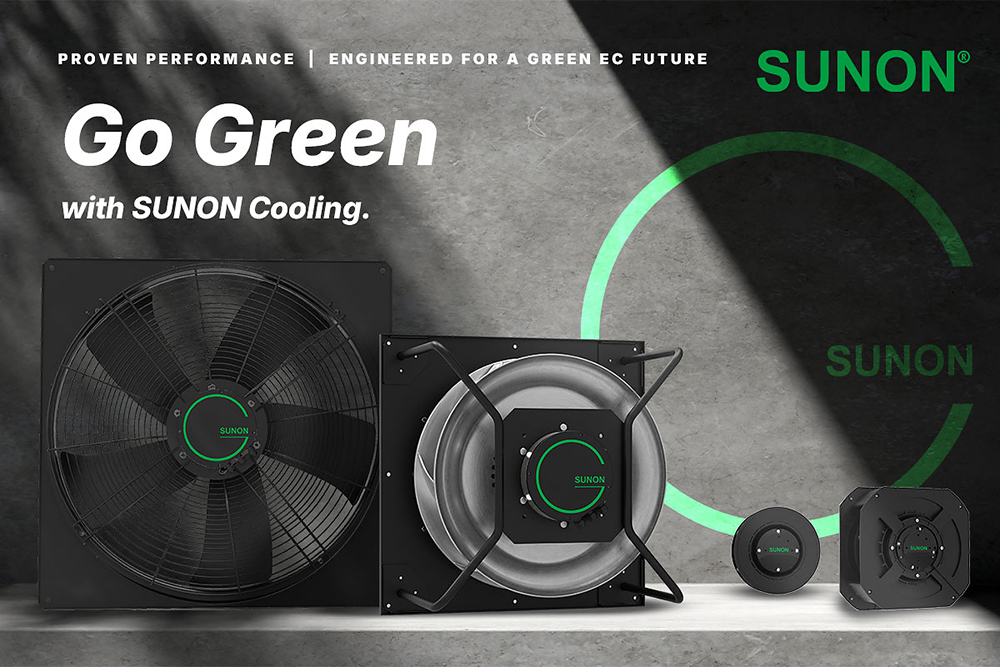
SUNON has launched its Green EC Fan Series, an ErP 2026-ready line of electronically commutated (EC) fans aimed at high-density computing environments, including AI infrastructure. The company is pitching the series around higher energy efficiency and expanded monitoring and control features aligned with EU ErP 2026 requirements.
For controls and telemetry, the Green EC Fan Series integrates Modbus-RTU communication and PWM speed control. SUNON says the onboard electronic control circuitry enables real-time status monitoring and supports “Dynamic Power Allocation compatibility,” with the host system adjusting fan speeds based on live thermal loads to reduce idle power consumption.
On the electrical side, SUNON lists wide-voltage support with auto-sensing circuitry for single-phase 200–277 VAC and three-phase 380–480 VAC architectures. The company also says its EC motor technology is designed to scale with “evolving 800 VDC infrastructure,” tying the platform to deployments beyond data centers, including HVAC, energy storage systems (ESS), and EV charging stations.
For environmental hardening, SUNON describes IP55 and IP68 ingress protection variants. IP55 models are positioned for humid commercial refrigeration settings, while IP68 models are described as providing salt-spray corrosion resistance for outdoor deployments such as energy storage and EV charging stations. SUNON also states the series carries EU ATEX gas explosion-proof certification and is engineered with a “spark-free architecture” to reduce gas-ignition risk in hazardous locations.
The fan platform includes aerodynamic and motor design elements SUNON ties to airflow delivery and mechanical stability. SUNON says it used fluid dynamics simulation to redesign the blades with increased curvature and surface area for a more concentrated airflow profile and longer air-throw distances. The series also incorporates SUNON’s “vertical MagLev System,” paired with high-temperature-resistant VAPO sleeve bearings; the company says this combination reduces wobble and targets near-zero vibration and longer operating life.
For data center operators, the practical takeaway is the interface and power-architecture flexibility: Modbus-RTU and PWM are the kinds of hooks that can make fan energy and health visible to higher-level controls, while wide-voltage support can simplify global standardization. But ErP 2026-readiness is only meaningful in deployment if the total cooling system is instrumented and tuned well enough to actually use that telemetry to avoid wasted airflow.
“SUNON doesn’t just build fans; we engineer full-stack hardware and software protection to solve the friction between strict energy regulations and brutal operating conditions,” the company said.
Source: SUNON