
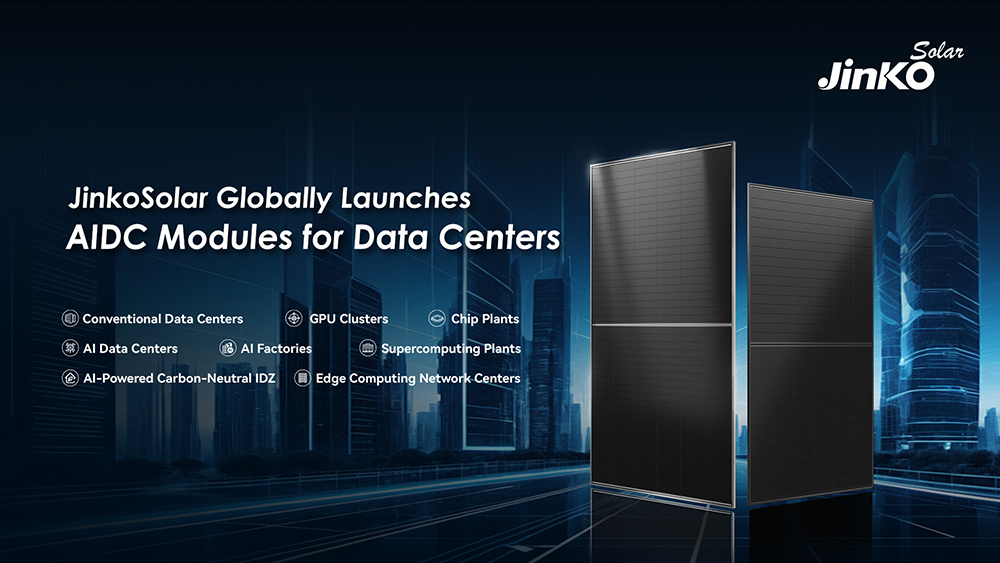
JinkoSolar has launched AIDC PV modules aimed at powering data centers, including conventional facilities, AI data centers, GPU clusters, supercomputing plants, edge computing network centers, chip plants, and “AI factories.” The modules are built on JinkoSolar’s Tiger Neo 3.0 TOPCon platform and are pitched for sites that prioritize continuous operation, asset protection, and resilience in harsh weather.
JinkoSolar lists front-side module efficiency of 24.8% or higher and nameplate power output of 670 W or higher for the AIDC line. The company frames the design goal as higher energy yield per available roof or land area, with lifecycle cost (LCOE) as the optimization target.
On bifacial performance, JinkoSolar specifies bifaciality of 85% ± 5% using its Tiger Neo 3.0 TOPCon platform and “MAX technology.” As a worked example, the company says a 670 W module at 85% bifaciality can reach 844 W total output under 0.26 ground reflectance conditions. For data center operators looking at on-site generation, the practical detail here isn’t the branding—it’s how much backside contribution you can realistically count on at a given albedo, because that drives layout choices, row spacing, and yield modeling assumptions.
JinkoSolar also highlights low-irradiance behavior. In the 100–200 W/m² irradiance range (conditions the company associates with dawn, dusk, overcast, and rain), it says morning and evening generation can be increased by up to 8.93% compared to BC modules. Under “extreme low-light scenarios” such as dense fog or building shading, it lists relative power output stability of 95%–98%. For facilities trying to increase the share of self-consumed energy, low-light response can matter as much as peak output, because data center load doesn’t follow the solar curve.
On safety and durability, JinkoSolar says the modules are designed to meet IEC 61730-2:2023 and UL 790 Class A requirements, including flame spread ≤ 1.82 m and surviving a 30 cm × 30 cm glowing wood block test without burning through. It also specifies UL 94 V-0-rated insulation materials (self-extinguishing within 10 seconds, with no burning droplets) and testing under IEC 60695. The assembly includes what JinkoSolar describes as a patented arc-resistant junction box and connection technology intended to reduce DC arcing risk.
For extreme weather, JinkoSolar states the modules passed a 55 mm hail impact test (compared to a conventional 25 mm test standard referenced by the company) and mechanical load testing of 6,000 Pa front-side and 4,000 Pa rear-side. It ties that to snow pressure “exceeding 600 kilograms per square meter” and to roof security in typhoon-prone regions.
Source: JinkoSolar