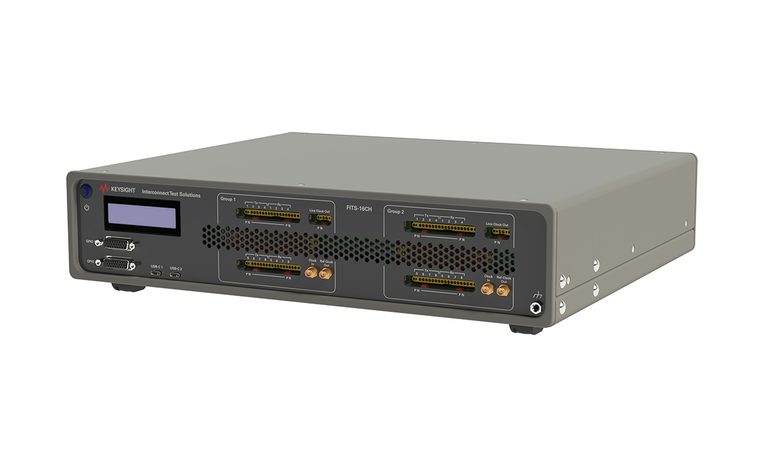
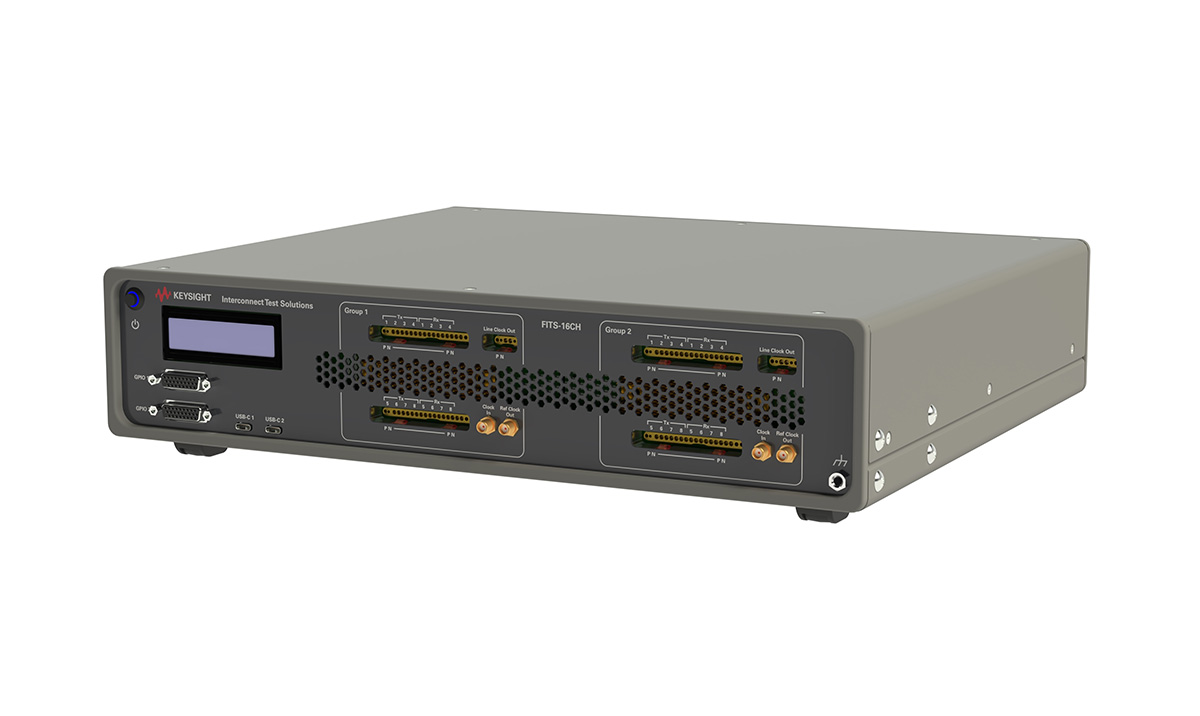
Keysight has added a higher-channel-count system to its Functional Interconnect Test Solutions lineup, targeting digital-layer error performance validation for 1.6T copper and optical interconnects used in scale-out data centers. The new FITS-16CH is built for validating complete interconnect assemblies, not just physical-layer compliance.
FITS-16CH provides 16 transmit and 16 receive channels, doubling the channel density of the FITS-8CH system. Keysight is aiming it at use across R&D, product design, manufacturing, and pre- and post-production AI and network infrastructure deployments where engineers need to qualify full links under conditions that look more like real systems.
At the measurement layer, FITS-16CH combines bit error ratio (BER) and forward error correction (FEC) measurements at the digital layer to evaluate system-level error performance. It supports 106G and 212G lane-rate validation for current 800G interconnects and emerging 1.6T technologies. For data center builders, that matters because pushing lane rates up tightens margins, and the problems that show up in complete assemblies (including connectors, retimers, host interfaces, and fixtures) don’t always appear in isolated electrical or optical compliance testing.
Keysight lists support for a wide range of interconnect types: full-retimed optics (FRO), active optical cables (AOCs), linear-retimed optics (LRO), linear pluggable optics (LPO), active copper cables (ACCs), active electrical cables (AECs), passive direct attach cables (DACs), and high-speed copper flyover cables used in networking and high-performance computing equipment. Keysight also positions the platform for development and manufacturing workflows for silicon chips, networking equipment, and interconnect products, plus performance benchmarking for data center operators.
On the test setup side, Keysight says FITS-16CH is designed to test fully assembled interconnects using two Module Compliance Boards (MCBs) with independent channel groups and MCB controls. Keysight also highlights a large insertion-loss budget intended to support validation across lossy channels and customer fixtures.
For automation, the FITS Windows 11 GUI integrates with the Keysight DCA-X to automatically calculate transmit finite impulse response (FIR) tap settings and open the electrical eye. Keysight says this automated lane tuning can reduce tuning time to a few minutes, compared with manual tuning that can take hours, days, or weeks. FITS-16CH can also integrate as a transmitter or receiver with Keysight data communications analyzers (DCAs), high-performance bit error ratio testers (BERTs), and UXR real-time oscilloscopes, with SCPI API support, pass/fail flagging, and PDF and .csv report generation.
“The tighter margins at 1.6T make it essential to evaluate active electrical cable performance at the system level, not in isolation for each link,” said Ameet Suri, Vice President of Product at Credo Technologies.
“FITS-16CH expands our functional interconnect validation portfolio with the capacity, flexibility, and automation needed to help engineers move from product development and qualification to mass production with greater confidence,” said Ram Periakaruppan, Vice President and General Manager, Network Test & Security Solutions at Keysight.
Source: Keysight