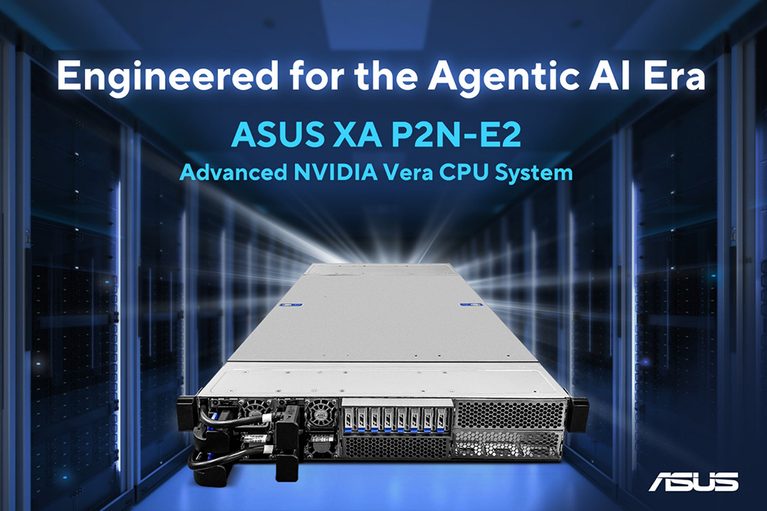
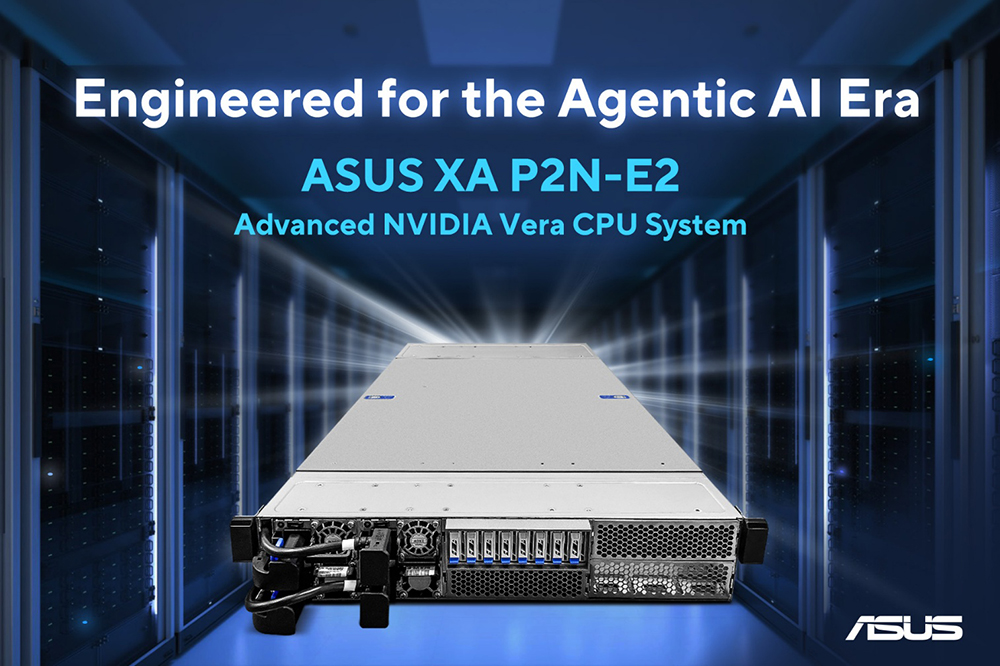
ASUS has added a new NVIDIA MGX-based server to its AI infrastructure lineup with the XA P2N-E2, a 2U platform built around NVIDIA Vera CPUs for agentic AI and reinforcement learning execution-layer workloads. The system was shown at OCP Global Summit 2026, with ASUS framing the box as an execution node for tasks that sit around the model, including code execution, tool use, sandboxing, data processing, and orchestration.
The XA P2N-E2 supports up to two dual-slot NVIDIA RTX PRO 6000 Blackwell Server Edition GPUs in a 2U chassis. ASUS is tying the design to high single-thread CPU performance and “high-bandwidth, energy-efficient memory,” aiming to keep agentic workflows responsive during execution and evaluation phases where CPU scheduling, data movement, and per-request overhead can dominate.
Execution-layer capacity is becoming a practical sizing problem for agentic stacks: even in GPU-rich environments, a lot of real work still lands on the host CPU once you start chaining tools, isolating code, or orchestrating multi-step flows. A 2U form factor with a modest number of dual-slot GPUs is also a reminder that not every AI system is a max-GPU training node—operators still need balanced servers to fill in the rest of the pipeline.
Broader rack and server portfolio shown at OCP
At the rack level, ASUS also highlighted the XA VR721-E3 “ASUS AI POD,” which integrates 36 NVIDIA Vera CPUs and 72 NVIDIA Rubin GPUs via the NVIDIA Vera Rubin NVL72 platform, using a fully liquid-cooled architecture. ASUS listed large-scale AI training, post-training, and inference as target uses for that rack-scale system.
For a different configuration, ASUS described the XR R1I12B-M1BHFS as pairing NVIDIA HGX Rubin NVL8 with direct-to-chip liquid cooling for the GPU baseboard, while using air cooling for Intel Xeon 6 processors.
Beyond compute, ASUS pointed to the NVIDIA DSX reference design and the NVIDIA Omniverse DSX Blueprint for AI Factory Digital Twins (part of NVIDIA DSXSim) as tools intended to combine validated architecture with simulation for AI factory design and operations ahead of deployment. ASUS also listed several NVIDIA platform elements alongside its systems, including NVIDIA Spectrum-X Spectrum-6 Ethernet switching, the NVIDIA CMX Context Memory Storage Platform, and NVIDIA Groq 3 LPX for the NVIDIA Vera Rubin NVL72.
Intel Xeon 6 and AMD EPYC 9006 systems
ASUS also cited Intel Xeon 6-based RS700-E12-RS4U (1U) and RS720-E12-RS12U (2U) dual-socket servers, and an AMD EPYC 9006-series (“Venice”) system, the RS700A-E14B-R16U, described as a 1U dual-socket platform with PCIe 6.0 connectivity and support for up to 16 E3.S drives. For thermal management, ASUS called out ASUS Thermal Radar 3.0 for thermal monitoring and management.
On the AMD accelerator side, ASUS listed ESC8000A-E13P with support for AMD Instinct MI350P PCIe accelerators, and XA AM3A-E13 integrating eight AMD Instinct MI355X accelerators in a 10U design, with air cooling across CPU and GPU components.
ASUS said its servers are available worldwide, with product and configuration availability varying by region.
Source: ASUS