
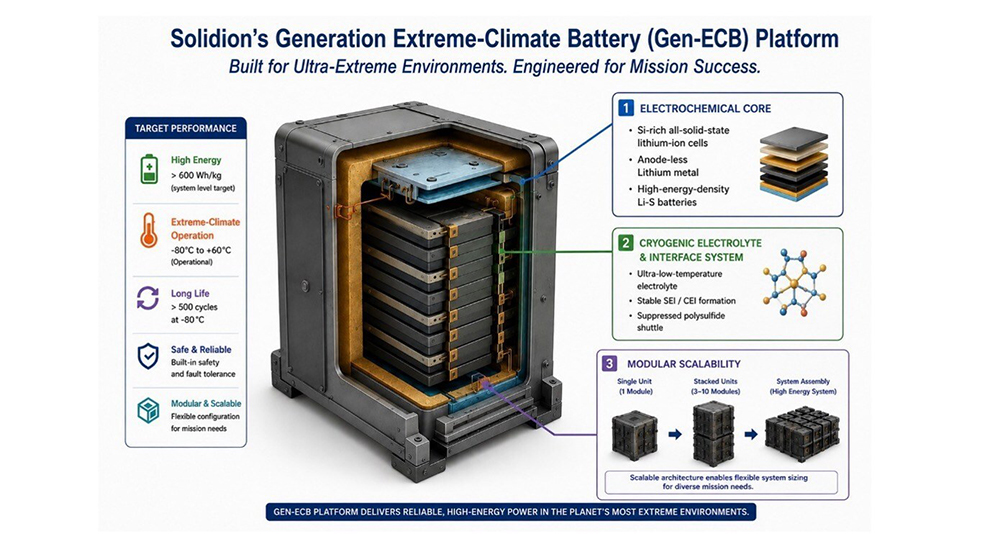
Solidion Technology has introduced its Generation Extreme-Climate Battery (Gen-ECB) platform, a patented battery approach aimed at satellites and other orbital hardware, including concepts such as Low Earth Orbit (LEO)-based AI data centers and future lunar infrastructure.
Gen-ECB uses graphene for thermal conductivity and radiation resistance, with the goal of actively regulating temperature inside battery cells. The company describes the approach as rapidly dissipating heat to help prevent thermal runaway and, when required, pulling warmth from external sources such as solar panels to support operation in extreme cold. Solidion says the system has been proven to operate from −80°C to +60°C, and it is continuing development for broader temperature ranges for deep-space missions.
For data center engineers watching space-based compute concepts, the practical constraint isn’t just energy density—it’s survivability across brutal thermal swings and radiation exposure, while keeping mass and safety margins under control. A battery architecture that can hold stable behavior across large temperature excursions can directly affect uptime and mission duration for any orbital platform that needs consistent power, whether that’s comms payloads or more speculative LEO compute infrastructure.
Solidion also pointed to other battery development work alongside Gen-ECB, including silicon-rich all-solid-state lithium-ion cells, anode-less lithium metal, and lithium-sulfur batteries. For the lithium-sulfur effort, Solidion cited a target of 380+ Wh/kg and described the use of non-flammable solid electrolytes for applications where weight and safety are critical.
For lunar-use cases, Solidion reported tested performance exceeding 500 charge cycles at −40°C. The company also said it has over 385 patents and referenced scaling US-based “green graphite” production, alongside silicon-anode development.
“Solidion’s Gen-ECB and advanced battery platforms deliver exactly that—stable, reliable energy storage engineered for the harshest environments humanity has ever operated in,” CEO Jaymes Winters said.
Solidion is headquartered in Dallas, Texas, and has pilot production facilities in Dayton, Ohio.
Source: Solidion Technology