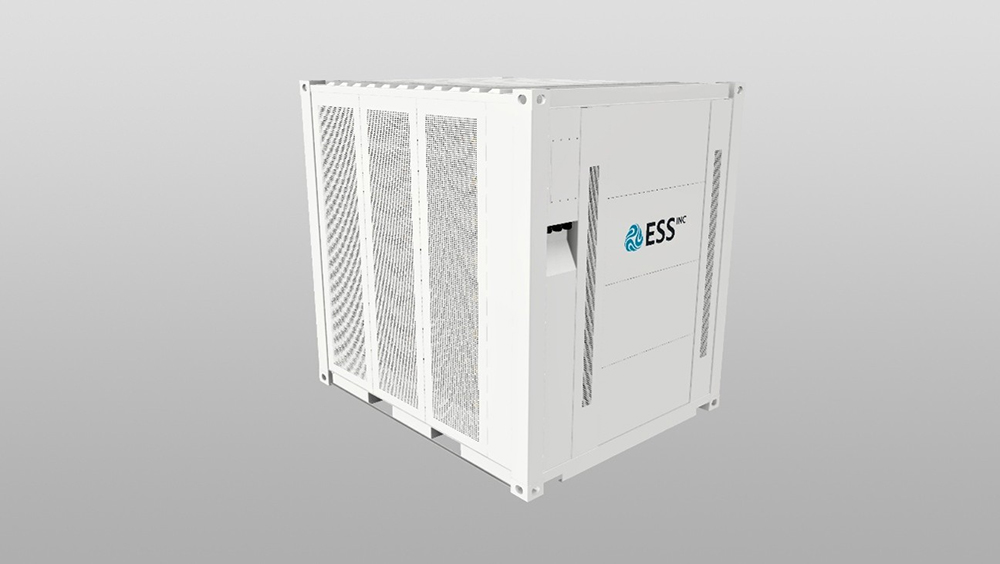
ESS has introduced Bridge, a modular sodium-ion battery energy storage system (BESS) aimed at grid-scale deployments, data centers, critical infrastructure, and commercial and industrial sites that want an alternative to lithium-ion.
Bridge is built as a 1.2 MWh “building-block” AC battery system. Each unit packages the battery cells, modules, racking, power conversion, cabling, and battery management system (BMS) hardware and software into a 10-foot container. ESS also includes an energy management system (EMS) intended to provide plant-level monitoring, optimization, and control.
For installation and site work, ESS describes Bridge as a plug-and-play unit that can be installed with a heavy-duty forklift and run with simple air cooling. The system is designed to stack modular blocks, scaling to 4.8 MWh in the same footprint as a traditional 20-foot battery container.
On the data center side, the interesting detail is the containerized, AC “building block” approach: 1.2 MWh increments are a straightforward way to think about capacity planning for ride-through, peak shaving, or facility-level resilience projects. But the practical design question will still come down to how the footprint, heat rejection with air cooling, and integration points (power conversion and controls) fit into a site’s electrical and operational constraints.
ESS says Bridge is designed to eliminate the risk of fire from thermal runaway and avoid complex HVAC or liquid cooling systems. ESS also states the system supports charge and discharge profiles from one to 16 hours or more, depending on configuration.
Bridge is designed to operate from -40° C to 50° C and has a 20-year operating design life. ESS also points to sodium-ion’s materials base as a way to reduce exposure to constrained critical minerals and geopolitical sourcing risk, and it says the platform can help customers manage exposure to Foreign Entities of Concern (FEOC).
“AI workloads are reshaping what data centers need from energy storage, and sodium-ion handles those power needs more effectively than conventional technologies,” said Drew Buckley, CEO of ESS. Randall Selesky, Chief Commercial Officer, said, “They want systems that improve safety, simplify operations, provide flexibility and support long-term energy security objectives.”
Source: ESS