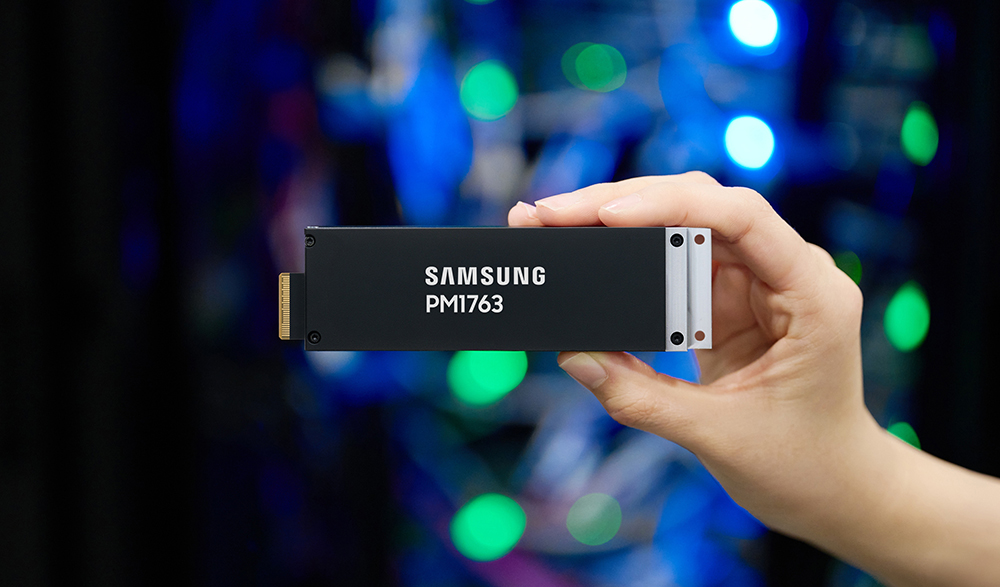
Samsung Electronics has begun mass production of its PM1763 enterprise SSD, a PCIe 6.0 drive aimed at AI and HPC server deployments. The PM1763 combines Samsung’s ninth-generation V-NAND with a newly developed 4 nm controller, targeting both throughput and power efficiency as storage pipelines get stressed by larger training datasets and higher-rate inference.
The PM1763 line comes in 4 TB, 8 TB, and 16 TB capacities. In the 16 TB configuration, Samsung lists sequential read speeds up to 28,400 MB/s and sequential write speeds up to 21,900 MB/s. Samsung also states that’s more than two times the performance of its predecessor, the PM1753. On the efficiency side, Samsung reports power efficiency improved by more than 1.8 times versus PM1753.
Samsung ties the PM1763 to AI platform behavior, using a concrete example: it says the drive can transfer a 40 GB large language model in about 1.4 seconds. The practical takeaway for data center architects is straightforward: PCIe 6.0 SSD bandwidth is now getting high enough that storage can better keep pace with accelerator-heavy nodes, especially when many jobs are contending for shared storage paths. But real-world impact will still hinge on the rest of the I/O stack—server PCIe topology, CPU lanes, and the network fabric behind the storage tier.
On thermal design, the PM1763 is optimized for liquid-cooled server environments using direct-to-chip (D2C) cooling. Samsung says this is intended to maintain peak performance under intensive workloads and extended operating conditions, a consideration as more AI racks adopt liquid to manage higher component-level heat flux.
The company also emphasizes security features for AI infrastructure. PM1763 supports post-quantum cryptography (PQC) algorithms intended to address future quantum threats, and it supports TEE Device Interface Security Protocol (TDISP) for securing data pathways in virtualized environments. Jangseok Choi, vice president and head of memory product planning at Samsung Electronics, said, “PM1763 has successfully completed validation for next-generation AI platforms.”
Source: Samsung Newsroom