
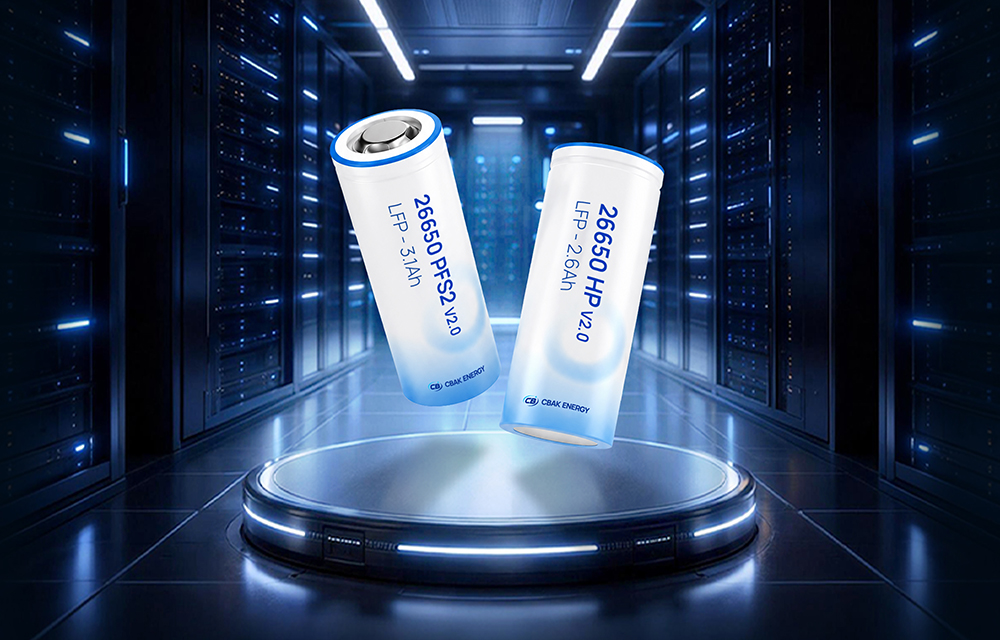
CBAK Energy has previewed two next-generation high-rate lithium iron phosphate (LFP) cylindrical cells aimed at AI data center battery backup unit (BBU) designs, with a path to broader uninterruptible power supply (UPS) use. The cells target fast, high-current response for millisecond-level power transients, a growing concern as GPU-heavy training and inference workloads drive higher rack power density and sharper load swings.
The cells are the 26650 HP V2.0 and 26650 PFS2 V2.0, both in a 26650 cylindrical form factor. CBAK specifies high continuous discharge rates of 40C for the 26650 HP V2.0 and 38C for the 26650 PFS2 V2.0. Under specified test conditions, the company also rates the cells for up to 100C pulse discharge. For single-cell power output, CBAK lists 260 W for the 26650 HP V2.0 and 310 W for the 26650 PFS2 V2.0.
For BBU designs, CBAK is also emphasizing internal resistance. The company lists “below 3 mΩ” internal resistance for these cells and contrasts that with “conventional 12 mΩ-class cells,” tying lower resistance to reduced losses and heat at high current during UPS-to-BBU switching events.
For UPS scenarios that need sustained discharge rather than short burst response, CBAK lists “more than 600 cycles” under specified 5C/10C test conditions and an operating temperature range of -40°C to 70°C. The company is framing these characteristics as relevant to longer-duration backup and lifecycle stability, where replacement cadence and thermal behavior can drive service cost and risk.
BBU response time requirements are unforgiving: the power path has to ride through fast transients and handoffs without destabilizing voltage or overheating cells. High C-rate and low internal resistance can help, but the practical result depends heavily on pack architecture, busbar design, protection settings, and thermal management. CBAK notes that the performance data it provided comes from internal lab testing under specified conditions and that actual performance may vary with system design and operating environment.
CBAK says it plans to share additional product details, application guidance, and availability updates in a future product release, and it is inviting early technical discussions with BBU solution providers, battery pack companies, UPS manufacturers, data center infrastructure partners, and critical power system integrators.
Source: CBAK Energy