
Intel used Hot Chips 2026 to detail three “agentic AI” system architectures spanning the data center and the edge: the Xeon platform codenamed Diamond Rapids for orchestration, the Crescent Island GPU for inference, and the Intel Core Series 3 platform codenamed Wildcat Lake for client and edge deployments.
Across the stack, Intel tied the designs to its own manufacturing and packaging technologies, including the Intel 18A process family, Foveros Direct 3D packaging, and UCIe-based chiplet interconnects.
Diamond Rapids: Xeon platform details
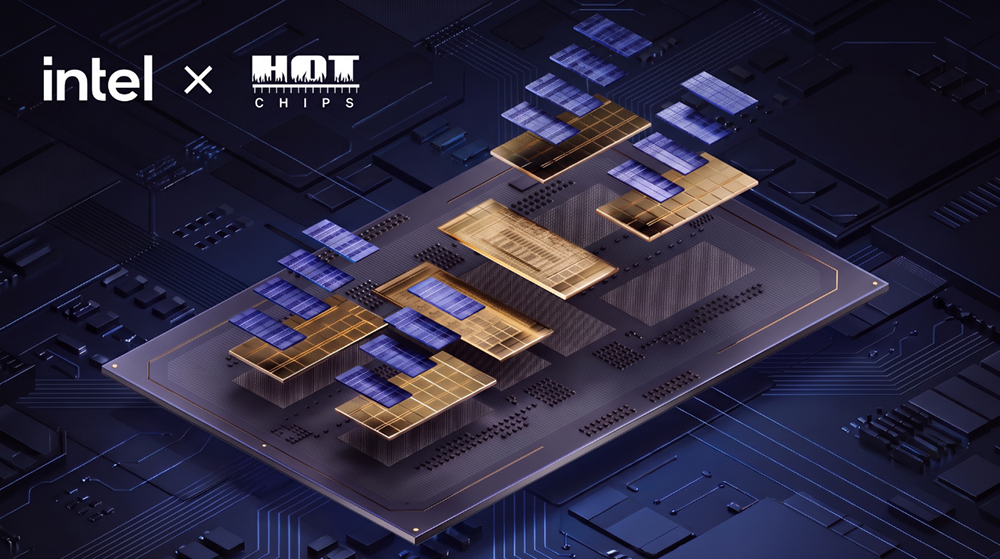
Diamond Rapids is Intel’s next-generation Xeon platform aimed at enterprise-scale agentic AI workloads. Intel said the processor introduces a new architecture that combines “adaptable compute building blocks,” a unified memory fabric, and flexible I/O, and it highlighted SoC construction using Foveros Direct 3D and a UCIe-S interconnect.
Intel listed Diamond Rapids specs that include up to 256 new cores with 1.28 GB of LLC, 16 memory channels at 12,800 MT/s, and 128 lanes of PCIe Gen6 with CXL 3.0. Intel also called out a high-bandwidth memory subsystem, new Advanced Performance Extensions (APX), and enhanced Advanced Matrix Extensions (AMX) for AI acceleration.
Crescent Island: air-cooled inference GPU
Intel also described Crescent Island, a data center GPU architecture optimized for AI inference. The company positioned it as a lower-power, easier-to-deploy option intended to fit “existing air-cooled data center footprints,” with an emphasis on token throughput and reduced cooling demands.
Crescent Island is specified as a 350 W air-cooled PCIe card with 32 Xe cores and 256 XMX engines based on Xe3P, plus up to 480 GB of LPDDR5X memory.
Wildcat Lake: Core Series 3 for client and edge
For client and edge systems, Intel pointed to Wildcat Lake—launched as Intel Core Series 3 processors—built on Intel 18A. The platform combines CPU cores aimed at x86 single-thread performance with integrated Xe3 graphics featuring XMX acceleration, plus an NPU rated at up to 17 TOPS for “Hybrid AI.” Intel also said Wildcat Lake is its first processor to use UCIe, enabling multi-chip package designs.
Wildcat Lake specs listed include two performance cores and four efficiency cores, support for up to LPDDR5X-7467, and integrated WiFi 7 and Bluetooth 6.0.
For data center engineers, the practical takeaway is that Intel is putting specific I/O and memory numbers on the table for its next CPU platform (PCIe Gen6, CXL 3.0, and 16 memory channels), while framing Crescent Island as an inference card designed to stay inside air-cooled power and thermal envelopes at 350 W.
“Agentic AI is fundamentally changing how we design and deliver computing—from the transistor and package up through the full system architecture,” said Pushkar Ranade, Intel chief technology officer.
Source: Intel