AUO is bringing two AI-infrastructure-relevant technologies to SEMICON Taiwan 2026: a system-level Micro LED co-packaged optics (CPO) optical communication module and glass core substrates (GCS) for advanced semiconductor packaging. The company plans to show the Micro LED optical communication solution at the Daxin Materials booth and the GCS packaging work with Corning at Corning’s booth.
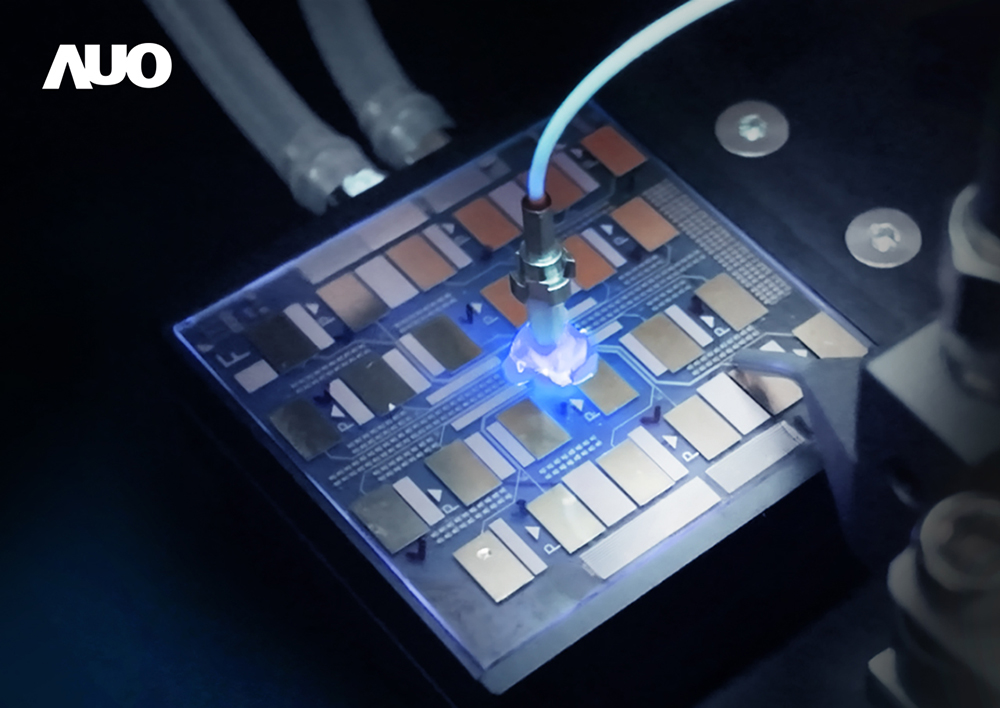
For the optical side, AUO describes a system-level Micro LED CPO module aimed at high-speed, short-reach interconnects up to 10 m in AI data centers. The integration work spans mass transfer, redistribution layer (RDL) packaging, optical coupling, and system architecture design. The module integrates Micro LED transmitters from Ennostar and Micro photodetector receivers from Tyntek, with Daxin’s photosensitive dielectric materials expected to be incorporated into the RDL packaging structure. Corning is also part of the ecosystem work on the optical fiber portion of the solution, targeting applications including CPO and active optical cables (AOC).
AUO’s technical pitch is a “wide-and-slow” parallel architecture: instead of pushing fewer optical channels to very high speed, the design uses a large array of Micro LED channels to carry aggregate traffic. The practical implication for data center engineers is straightforward: if you can reduce reliance on power-hungry signal compensation, you can ease thermal constraints at the edge of the switch or accelerator package, where every watt is painful to remove.
AUO lists Micro LED light-source figures for the transmit side including thermal stability up to 125°C and an operational lifetime of more than 30,000 hours, alongside “ultra-low power consumption.” Those characteristics are positioned as a fit for high-density, energy-efficient computing environments.
On advanced packaging, AUO is pairing its RDL process technology with Corning’s semiconductor-grade glass to demonstrate GCS aimed at larger AI server processor dies, high-density interconnects, and low-loss signal transmission. AUO also describes ongoing work across glass via (TGV) formation, via metallization, and reliability validation.
AUO attributes GCS benefits to low coefficient of thermal expansion, high dimensional stability, and low signal loss, saying the substrates can mitigate warpage in large-format packages while supporting higher-density circuit designs and high-speed data transmission. The blunt read: warpage and signal integrity are two of the most common ways advanced packages get expensive fast, so anything that meaningfully improves both is worth tracking, even before it’s tied to a specific product SKU or deployment.
“Future competitiveness will depend not only on advances in individual components, but also on system-level integration across materials, components, and modules,” said Wei-Lun Liao, chief technology officer of AUO.
AUO materials for SEMICON Taiwan 2026 are being shown through AUO Group company Daxin Materials and in collaboration with Corning, alongside ecosystem partners Ennostar and Tyntek.
Source: AUO