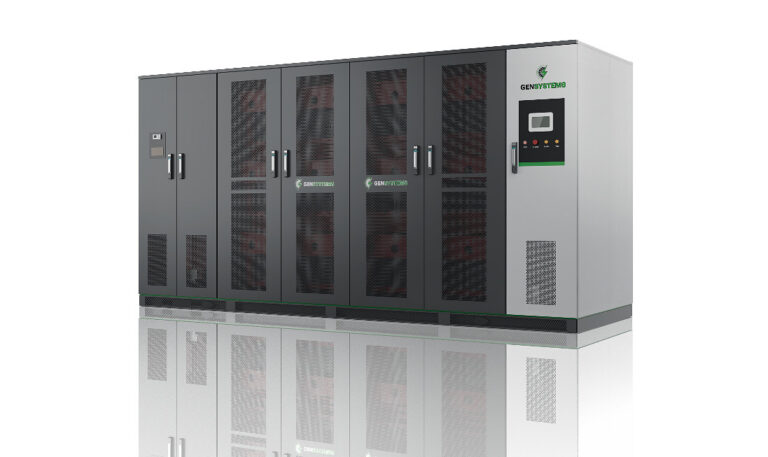
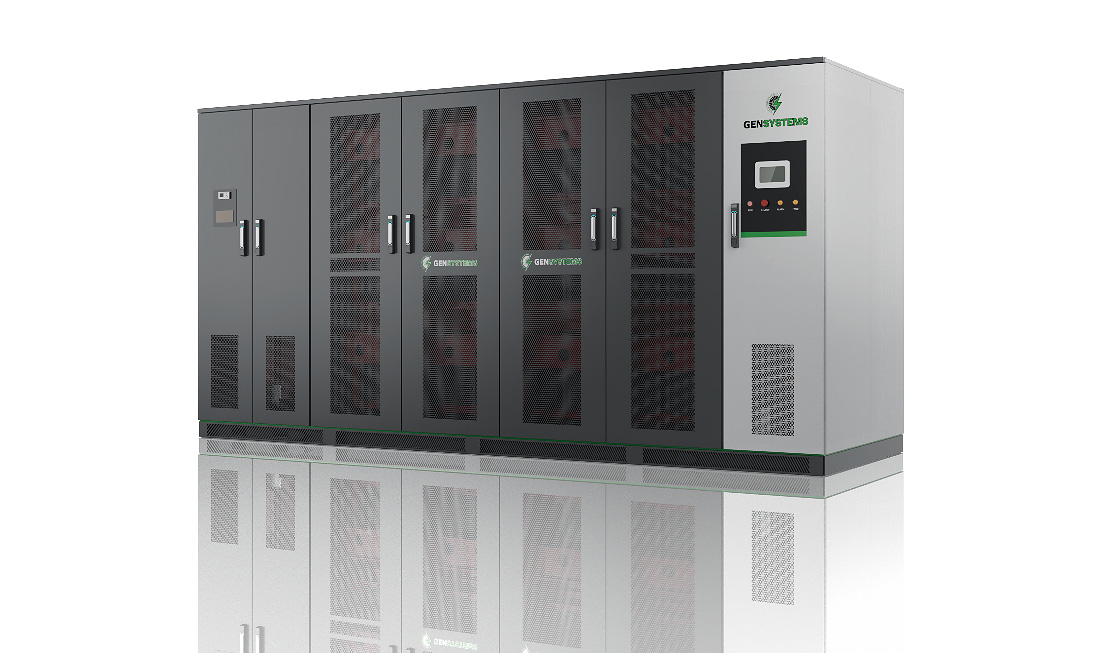
Jereh Group, through its wholly owned subsidiary GenSystems Power Solutions, introduced the PowerVEGA SST solid-state transformer (SST) for AI data centers at RE+ 2026 in Las Vegas. The system is built around an 800 V DC output architecture and is pitched as an integrated power-conversion and microgrid coordination platform for high-density AI infrastructure.
PowerVEGA SST uses a “direct gas-turbine-to-SST coupling” architecture that ties gas-fired generation to power electronics. The unit is rated at 3 MW and lists 98.5% peak efficiency. GenSystems positions it as a single platform that combines roles typically split across multiple blocks, including transformer functions, power distribution, UPS systems, and power quality management.
On the electrical side, the published specs list a 13.8 kV AC, 60 Hz input and an 800 V DC rated output. GenSystems lists voltage regulation accuracy of ≤ ±1%. For controls, the unit includes a 10-inch color touchscreen. Cooling is specified as forced-air cooling. Environmental limits in the spec table include an operating temperature range of 23° F to 140° F and site elevation up to 6,562 ft.
Physically, the unit is listed at 15.09 ft × 4.92 ft × 7.71 ft (L×W×H). The spec sheet also cites power density figures of 434 kW/m² and 40.4 kW/ft².
For data center engineers, the core bet here is that tighter integration between generation, conversion, and DC delivery can reduce the number of separate power blocks that have to be designed, commissioned, and maintained. But with forced-air cooling called out explicitly, the practical question will be how operators want to site and service a 3 MW power-electronics system in real facilities, including noise, filtration, and maintenance access, along with how that ties into established electrical rooms and safety practices.
GenSystems also highlights factory prefabrication “enabling on-site commissioning within 8 hours,” a “300-second hot-swap replacement” for faulty power modules, and the use of 2,300 V SiC technology that it says reduces component count by 51%.
Source: Gensystems Power Solutions