
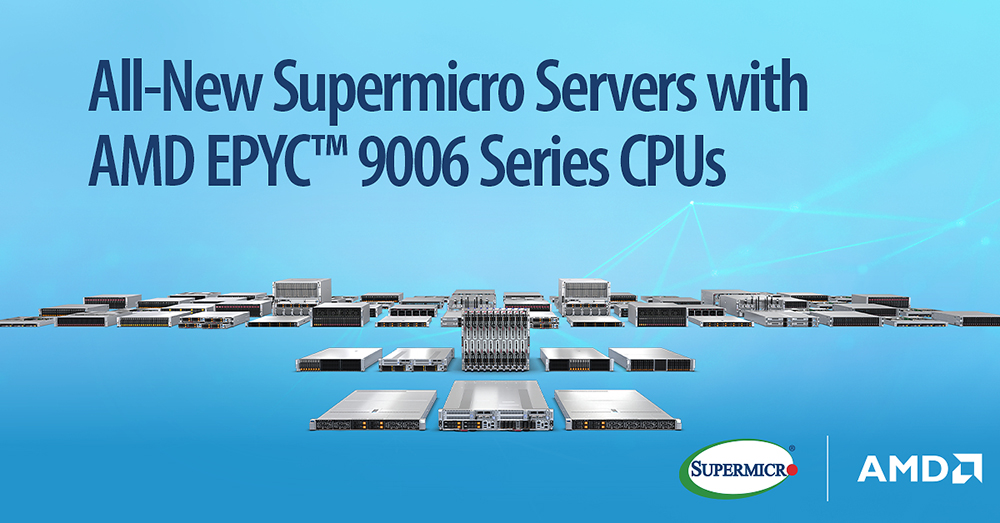
Supermicro has expanded its H15 server portfolio around 6th Gen AMD EPYC 9006 Series CPUs, with configurations aimed at cloud, enterprise, storage, HPC, and AI deployments. The lineup is also designed to pair with AMD Instinct GPUs and AMD Pensando networking, targeting dense, bandwidth-hungry infrastructure builds.
Supermicro highlights platform-level I/O and memory gains alongside the new CPU support, including “33% more cores,” “2X PCIe bandwidth,” and “2.6X higher memory bandwidth.” Across the H15 family, systems scale up to 256 cores and 512 threads. Supermicro also cites a “1.7x generational CPU performance improvement,” a forward-looking number that operators will want to validate against their own mix of AI, virtualization, and storage-heavy workloads before treating it as a planning input.
H15 systems and form factors
The H15 portfolio spans multiple chassis and deployment models. Hyper is a dual-socket platform targeted at enterprise applications, AI inference, virtualization, and cloud workloads, and includes an “advanced thermal design” intended to support the highest-performance EPYC processors. CloudDC is offered in single-socket and dual-socket variants and is built on the Open Compute Project (OCP) Data Center Modular Hardware System (DC-MHS) specification. GrandTwin is a 2U, four-node system aimed at scale-out use cases such as object storage, virtualization, cloud services, and HPC.
For high-density compute, FlexTwin is a 1OU, two-node, dual-CPU system designed for cloud-native and hyperscale deployments using liquid cooling. On the storage side, Petascale Storage is described as 1U and 2U all-flash platforms supporting up to 4.8 PB per system. SuperBlade is an 8U, 10-system platform that supports single-socket and dual-socket blade configurations, with both air- and liquid-cooled versions.
GPU and networking additions
On the accelerator side, Supermicro is adding 5U PCIe GPU servers—the AS-5126GS-TNRT and AS-5126GS-TNRT2—built for AMD Instinct MI350P PCIe GPUs. In an air-cooled 5U chassis, the systems support up to 10 GPUs. Supermicro lists MI350P features including up to 144 GB of HBM3e memory and support for low-precision AI formats.
For Ethernet-based AI fabrics, Supermicro points to the AMD Pensando Pollara 400 AI NIC for front-end, storage, and scale-out connectivity for MI350P-based systems. That’s a straightforward architectural choice for operators standardizing on Ethernet for AI clusters, but practical outcomes will still come down to end-to-end design details like oversubscription, buffering behavior, and how cleanly the NIC and GPU stack integrate into the software environment.
72-GPU rack-scale Helios platform
Supermicro also describes the Supermicro AMD Helios Platform, a 72-GPU, liquid-cooled rack-scale system for large-scale AI training and high-throughput inference. The platform combines AMD Instinct MI455X GPUs, 6th Gen AMD EPYC processors, AMD Pensando networking technologies, and the AMD ROCm software stack.
“By combining the latest AMD EPYC CPUs, Instinct GPUs, and AMD Pensando networking with Supermicro’s modular server and rack-scale designs, customers can deploy AI infrastructure faster while improving utilization, reducing energy consumption, and lowering total cost of ownership,” said Dan McNamara, senior vice president and general manager, Compute and Enterprise AI, AMD.
Source: Supermicro