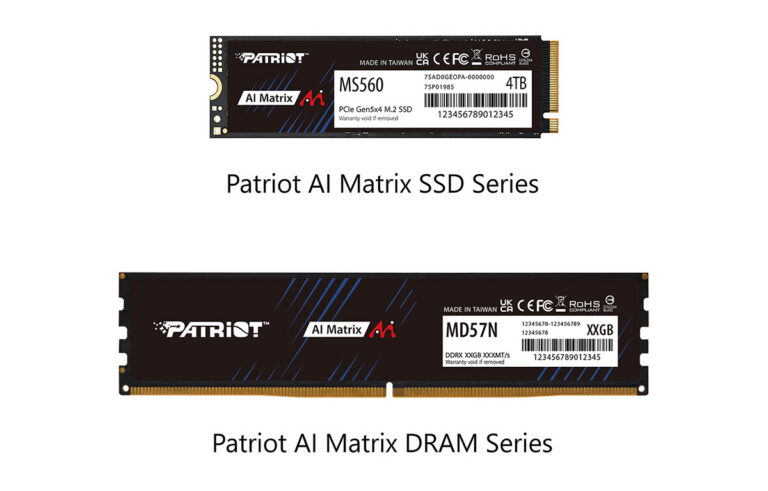

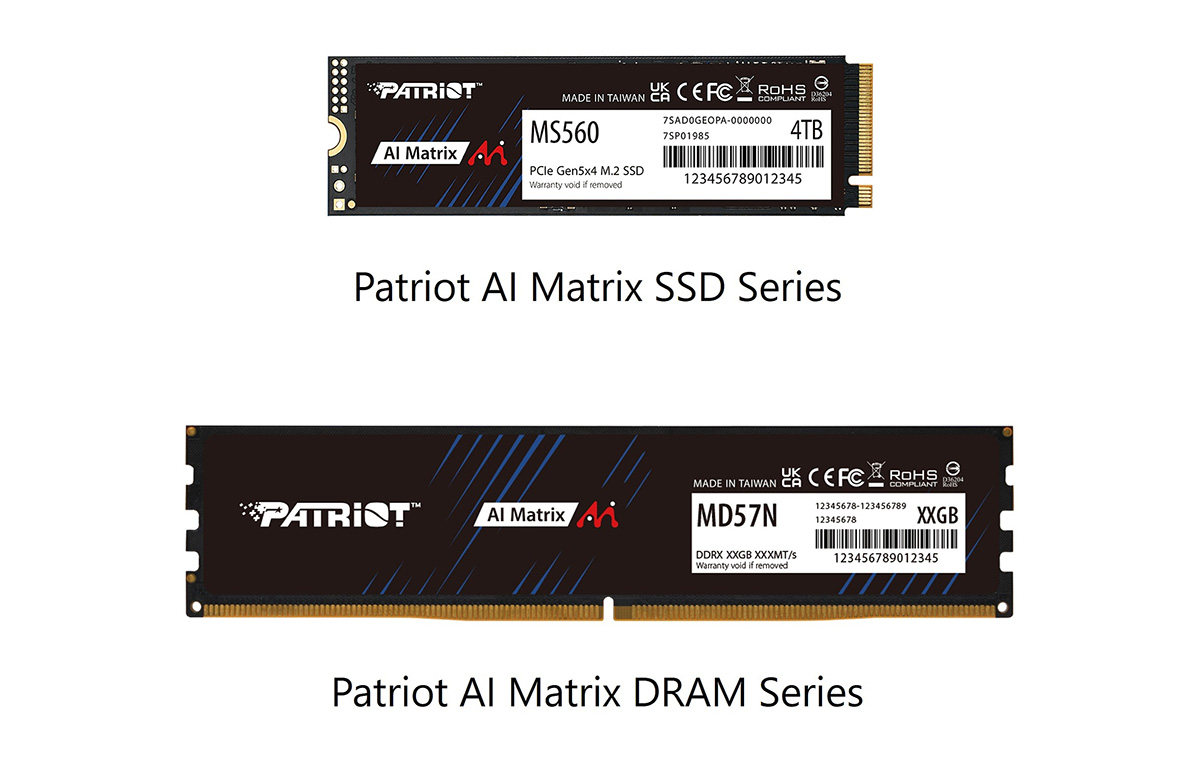
Patriot Memory has introduced the Patriot AI Matrix series, a lineup of DDR5 memory modules and PCIe M.2 2280 NVMe SSDs aimed at local AI computing. The portfolio is split into PRO, Mid, and Entry tiers, pairing specific DDR5 configurations with PCIe Gen5, Gen4, or Gen3 NVMe SSD options for on-device AI workloads.
For infrastructure teams and system builders pushing “local AI” beyond demos, the constraints often show up in memory capacity and storage behavior rather than raw GPU compute. Keeping larger models resident, feeding multi-channel memory consistently during token generation, and repeatedly loading checkpoints or working with local datasets can punish DRAM stability and SSD endurance.
AI Matrix SSD and DRAM lineup
The PRO tier includes the AI Matrix MS560 SSD, a PCIe Gen5 x4 M.2 2280 drive offered in 1 TB, 2 TB, and 4 TB capacities. Patriot lists sequential performance up to 14,000 MB/s read and 11,000 MB/s write for the 4 TB model. On the memory side, the PRO-tier AI Matrix MD57N DDR5 is rated up to 6000 MT/s (OC) and is available as a 64 GB (2 x 32 GB) UDIMM kit.
The Mid tier pairs the AI Matrix MS450 SSD (PCIe Gen4 x4, M.2 2280) in 1 TB, 2 TB, and 4 TB capacities with listed sequential speeds up to 5,000 MB/s read and 4,500 MB/s write. The matching AI Matrix MD55N DDR5 is rated up to 6000 MT/s (OC) and comes as a 32 GB (2 x 16 GB) kit.
The Entry tier uses the AI Matrix MS350 SSD (PCIe Gen3 x4, M.2 2280) in 512 GB, 1 TB, and 2 TB capacities, with listed sequential speeds up to 3,000 MB/s read and 2,000 MB/s write. Patriot pairs that tier with AI Matrix MD35N and MD34N DDR5 at 5600 MT/s, offered as a 32 GB (2 x 16 GB) kit.
Monthly benchmarking on open-source LLMs
Patriot says each tier is validated with monthly benchmark testing across open-source LLMs including Llama, Gemma, and CodeLlama. The company says it measures prompt-processing (pp512) and token-generation (tg128) responsiveness, and runs extended continuous local AI stress testing intended to verify sustained thermal and operational stability.
For operators and integrators, the most practical takeaway is that Patriot is packaging DDR5 and NVMe choices as a matched set for specific local AI build targets. Whether the “tier-to-model-size” mapping holds for your exact stack will still come down to the full system design, including CPU memory channels, cooling, and sustained SSD performance under real write workloads.
Source: Patriot Memory