
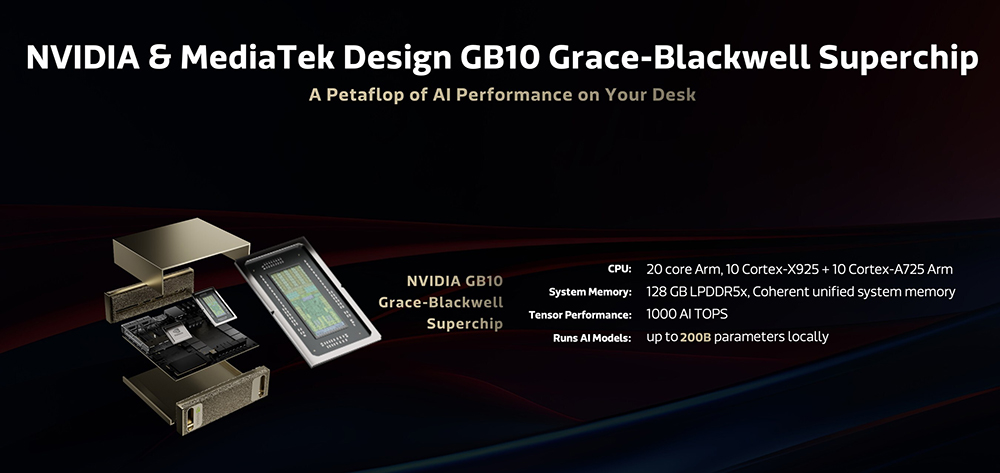
MediaTek has announced its collaboration with NVIDIA on the GB10 Grace Blackwell Superchip, engineered for use in the NVIDIA DGX Spark personal AI supercomputer. This system enables developers to prototype, fine-tune, and perform inference on large artificial intelligence (AI) models directly on the desktop. MediaTek reports that DGX Spark is now publicly available following its initial announcement earlier in 2024.
The GB10 Grace Blackwell Superchip integrates MediaTek’s experience in high-performance, power-efficient central processing unit (CPU) design, memory subsystems, and high-speed interfaces. It powers the Grace 20-core Arm architecture CPU and is combined with the Blackwell generation graphics processing unit (GPU) and 128 GB of unified memory. According to MediaTek, this combination enables up to one peta-floating point operations per second (PFLOP) of AI performance, supporting model development and real-time inference for large AI models up to 200 billion parameters. The included ConnectX-7 networking technology also enables two DGX Spark systems to be connected together, allowing inference on models up to 405 billion parameters.
MediaTek notes that DGX Spark offers a compact, power-efficient form factor suitable for standard desktop environments and standard electrical outlets, making high-end AI development more accessible outside traditional server rooms.
“DGX Spark will usher in the next era of AI prototyping and advance our mission of making great technology more accessible from the edge to the cloud, while solving performance and power consumption challenges,” said Vince Hu, Corporate Vice President of MediaTek’s Data Center and Compute Business Group. “The GB10 Superchip utilizes our high-performance computing expertise for the data center in combination with our power savings technologies for consumer devices, custom-built to run AI workloads.”
MediaTek states that it continues to work alongside NVIDIA across industry verticals, including hyperscale data centers, Internet of Things (IoT) applications, and software-defined vehicles.
Source: MediaTek