
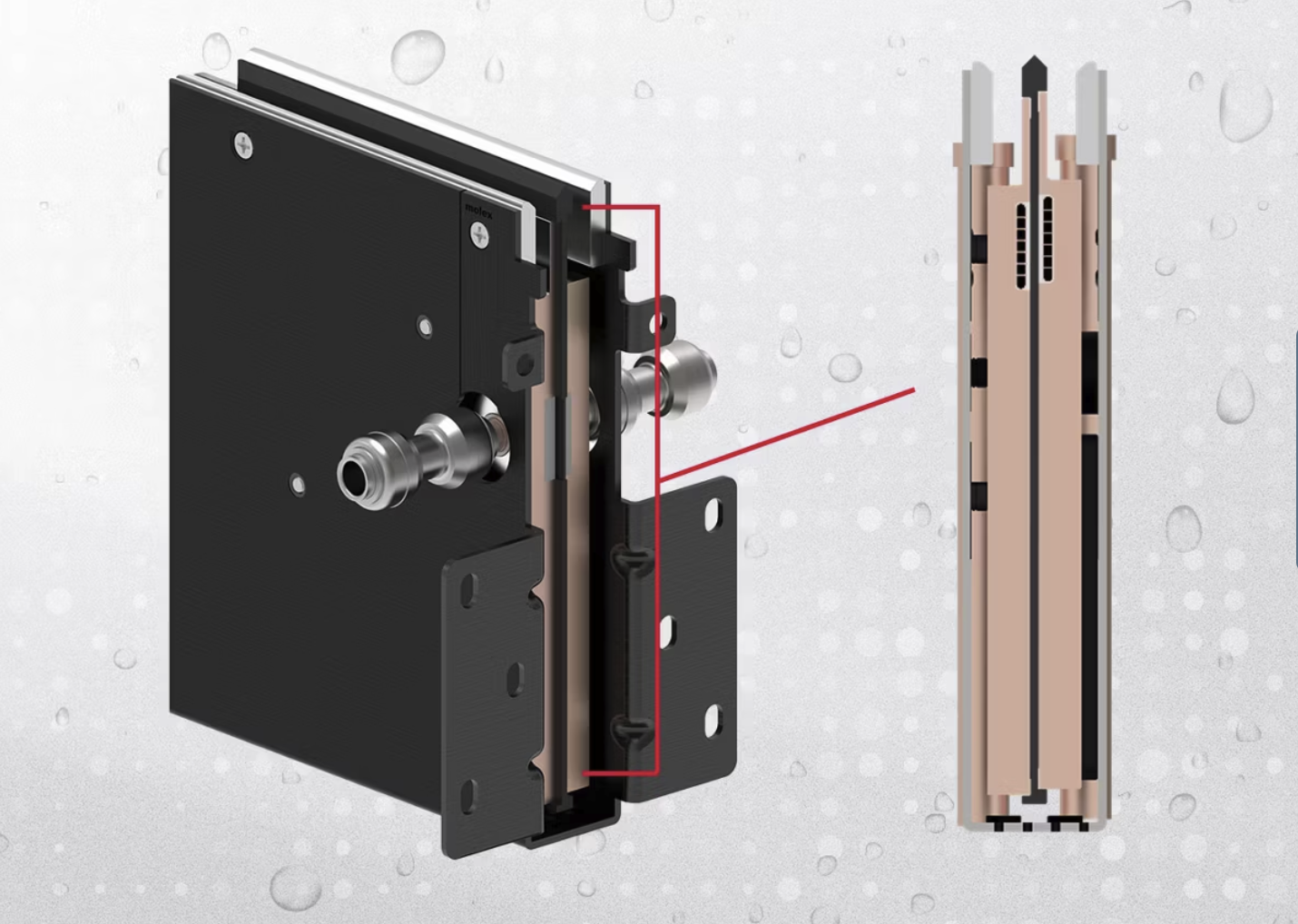
Molex has introduced its Multi-Channel Liquid Cooled Busbars, extending liquid cooling into the rack power-distribution layer as AI racks push toward the 1 MW threshold. The company says the design supports currents up to 15,000 A today, with a design roadmap to 25,000 A.
The Multi-Channel Liquid Cooled Busbars segment the coolant path into as many as seven discrete channels rather than a single-channel fluid path. Molex ties the multi-channel approach to more uniform heat extraction, with the goal of reducing hot spots and thermal stress while improving electrical performance stability at high current. For a headline spec, Molex lists a 15 °C temperature rise (T-Rise) at 15,000 A.
Thermally managing the power path is becoming its own scaling constraint as operators stack higher-current busbars into tighter rack volumes. Moving coolant closer to the conductors can reduce resistive heating problems that typically force bigger copper, more spacing, or more airflow—and all of those fight density. But the practical question for data center engineers is how easily a liquid-cooled busbar can be integrated into existing rack mechanicals and facility loops without creating new leak, serviceability, and commissioning burdens.
Molex is leaning on configurability to smooth integration. The busbars are designed to be tailored by length, depth, and fluid inlet/outlet points to fit tight layouts, and Molex describes a standard plug-and-play interface intended to enable a transition to liquid cooling without a rack redesign.
For mechanical compatibility, Molex says the busbars maintain footprint compatibility with ORV3 and HPR standards, targeting data center and AI rack applications where operators want to pre-install higher-capacity power infrastructure ahead of next-generation accelerators and 1 MW rack architectures. Molex also says the busbars are compatible with both dielectric and non-dielectric liquids, which would allow integration into different cooling-loop approaches.
On performance comparisons, Molex points to its own simulation data: the seven-channel architecture yields up to 20% greater cooling efficiency compared to a single-channel design, while staying within the same mechanical footprint.
“Direct-to-chip cooling is now standard for compute, but for AI to truly scale, we must also address the thermal challenges of the power path,” said Kevin Alberts, VP and GM of the Power and Signal Business Unit at Molex. “By integrating liquid cooling into the power backbone with our new Multi-Channel Liquid Cooled Busbars, Molex enables customers to maintain stable electrical performance and reduce thermal stress without drastically increasing the physical footprint of the rack.”
Molex is showing the Multi-Channel Liquid Cooled Busbars at Computex 2026 alongside other infrastructure-focused technologies, including 448G connectivity, CPO, CPC, and XPO connectivity products, and fiber connectivity solutions from Teramount, a Molex company.
Source: Molex