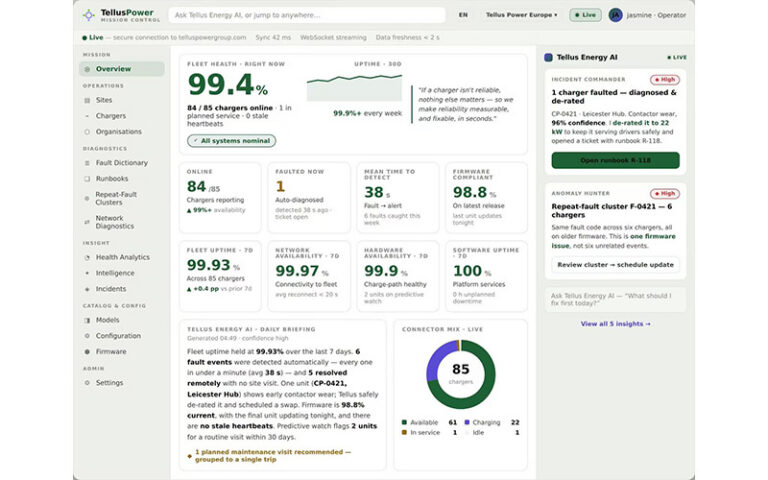

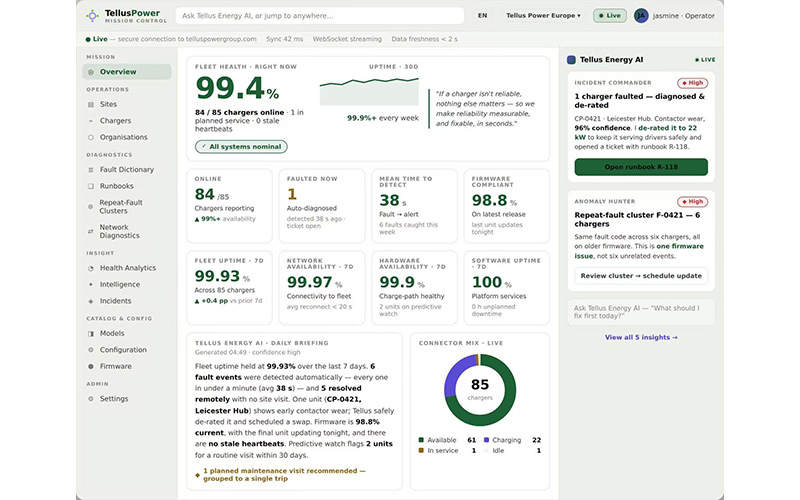
Tellus Power has launched Tellus Energy AI, a “vertical” AI model aimed at coordinating electricity procurement and scheduling for compute workloads, while also treating distributed charging and storage assets as grid-responsive resources. The model targets operators that are trying to align AI compute demand with real-time power availability and power pricing.
Tellus Energy AI is built around five stated capabilities: near-real-time wholesale electricity price tracking; power-load forecasting; energy decision support based on live prices and predicted load; grid coordination features that include energy arbitrage and responding to resilience, peak demand, and ancillary-service signals; and an open agent platform that lets customers build custom AI agents on Tellus Power’s TPResearch framework via published APIs.
For data center engineers, the practical idea is straightforward: if you can shift or shape flexible workloads (or energy storage and charging loads) against price and grid constraints, you can sometimes buy cheaper energy, reduce peaks, and create a cleaner operational story. But the hard part is operational integration—workload schedulers, facility power constraints, and grid program participation all have to line up, and the gains depend on how much of the load is actually moveable.
Tellus Power also described a broader integrated “energy-AI computing capability” it is building on four foundations: a vehicle-to-grid (V2G) virtual power plant, a wide-area charging network, liquid-cooled high-density compute clusters, and an energy-management platform (EMS). Tellus Power listed four applied models it intends to support with that stack: compute-power coordinated dispatch, V2G site operation, power-trading decisioning, and green-compute traceability for certification and ESG reporting.
In early deployments, Tellus Power is targeting electricity-cost reductions of 20%–40% versus “unoptimized operation,” data-center PUE below 1.1, and additional ancillary-service revenue of up to 40%. Those are ambitious targets, and operators should treat them as site-specific until they’re backed by measured baselines, utility tariff details, and verified M&V on workload shifting and grid services performance.
Tellus Power said it is opening three commercial offerings—Energy Intelligence Agent, private deployment, and an EMS smart toolkit—for partnership and integration with AI operators, data centers, and new-energy operators. “The compute exists, but the power to run it affordably and cleanly is the real constraint on AI’s growth,” said Mike Calise, CEO of Tellus Power.
Source: Tellus Power