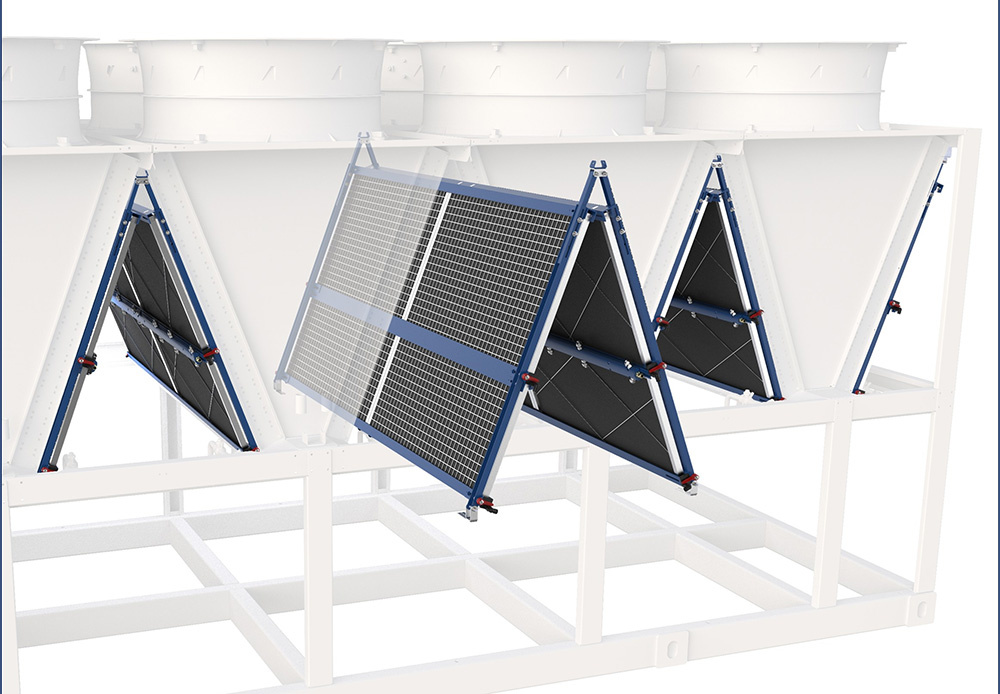
Peak+ has launched the Peak+ CORE adiabatic pre-cooling system, a new form factor designed to integrate directly into air-cooled chillers and other air-cooled equipment and support factory installation. The company is targeting data center campuses where higher power densities are making heat rejection harder and where “failing external CFDs” are becoming more common.
CORE is built for v-coil style air-cooled chillers and dry coolers, with frames positioned directly in front of condenser coils on v-coil air-cooled chillers, as well as other air-cooled condensers and radiators. Peak+ says the approach is aimed at high-temperature environments where suppressing condenser entering air temperature (CEAT) to the chiller system design temperature, or below, helps avoid chiller performance derate.
Like other Peak+ adiabatic pre-cooling systems, CORE is designed to achieve and maintain a specific targeted cooled dry bulb CEAT. Peak+ ties that control objective to minimizing water use, which puts CORE in the same design conversation as WUE-driven operating constraints: if you’re adding evaporative assist, the only version that works long-term is one where water consumption is controlled as tightly as the temperature target.
The company says CORE can be installed at an OEM factory or at off-site pre-fab facilities to reduce on-site assembly and integration work, and it can also be field-installed on existing equipment. Peak+ is pitching this as a way to accelerate time-to-revenue for developers seeking incremental power for additional IT loads and reduced “PPUE.”
Chris Curry, CEO at Peak+, said, “Data centers of all sizes are facing the same pressures: more heat, higher opportunity costs of misused energy, and increasing focus on water stewardship.”
CORE joins Peak+’s existing external frame-based pre-cooling system, now named HALO. Peak+ says its systems are based on 300+ US installations, including dozens of data centers, and an operational knowledge base with “millions of real-world data points.” The company lists outcomes that include solving failing external CFDs, reducing peak PUE, protecting condenser coils, mitigating hot air recirculation and chiller derate, increasing chiller peak cooling capacity by up to 40%, and reducing chiller compressor energy by up to 50%.
Peak+ says its systems are designed, engineered, and manufactured in the US, and that it commissions every site with its own team. CORE can be ordered directly from Peak+ or coordinated with “most major HVAC OEMs.”
Source: Peak+