
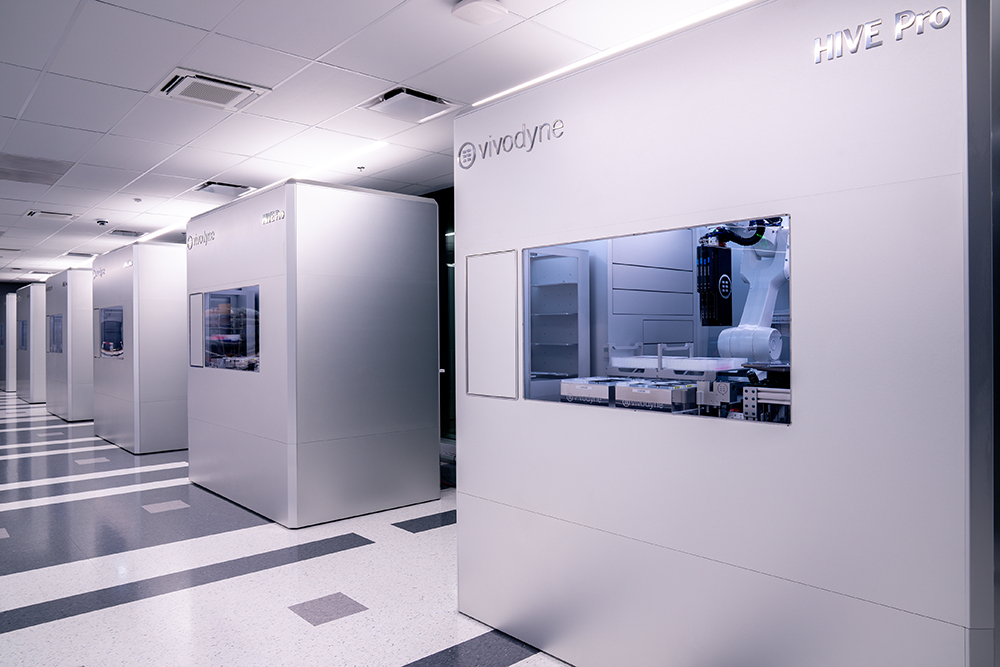
Vivodyne says it has built what it calls the world’s largest “human biological datacenter,” made up of 12 robotic HIVE laboratories with annual capacity for controlled trials on 3.1 million large human tissues. The company also introduced its Series 2 TissueDisk, a wafer-scale biological chip designed to grow hundreds of large, functional, living human tissues at the same time.
Vivodyne says TissueDisks are manufactured end-to-end on its own robotic production line, and that the disks run inside its robotic HIVE laboratories. Each lab is designed to operate automatically for weeks with unattended automation, covering cultivation, experimentation, and longitudinal data collection on tens of thousands of tissues at a time.
On the TissueDisk, Vivodyne describes each tissue as a “biological microprocessor,” where drug molecules and genetic perturbations are inputs and the living tissue’s response is the output. The system is built to run complex dosing regimens delivered through tissue blood vessels, perform multi-gene knockouts and activations, administer cell therapies and other modalities, and collect time-series measurements that include 3D scanning, transcriptomic sequencing, and deep proteomic analysis.
The practical takeaway for drug developers is straightforward: Vivodyne is trying to shift more decision-making earlier, by generating human-tissue response data before testing in people, and doing it at a scale that supports large experimental matrices rather than one-off studies. That’s an ambitious premise, and for engineers it reads like an attempt to turn wet-lab biology into a high-throughput, automated, data-generation pipeline—closer to how AI infrastructure is fed than how pharma R&D has traditionally run.
Vivodyne says its software platform and scientific ontology, called Hivemind, plans experiments, orchestrates the robotic labs, trains models on results, and selects which experiments run next. The company says each tissue starts from primary cells from human patients and grows to the size of large clinical biopsies studied by pathologists, with 200,000 to 500,000 cells per tissue. It also says the tissues self-assemble into structures with perfusable blood vessels, organ-specific function, and stroma and immune components, and that test compounds are delivered through the bloodstream “just as they would in a patient.”
Vivodyne says it grows more than 20 types of human organ tissues, including liver, lungs, gut, bone marrow, pancreas, kidney, eyes, and lymph nodes, with disease-linked variants spanning fibrosis, solid tumors, inflammation, metabolic disorders, and vascular disease. The company says it trains causal, multimodal AI models on experiments within each organ type, alone and combined.
“Prediction means knowing what happens when you try something new. And in pharma, almost everything we try is new,” said Tony Bahinski, Ph.D., chief biotechnology officer of Vivodyne and a member of the FDA’s science board.
Vivodyne says eight of the world’s largest pharmaceutical companies have paid for early access to the platform, and that partners have reserved trial-scale experimental capacity within its facilities in the San Francisco Bay Area and Philadelphia.
Source: Vivodyne