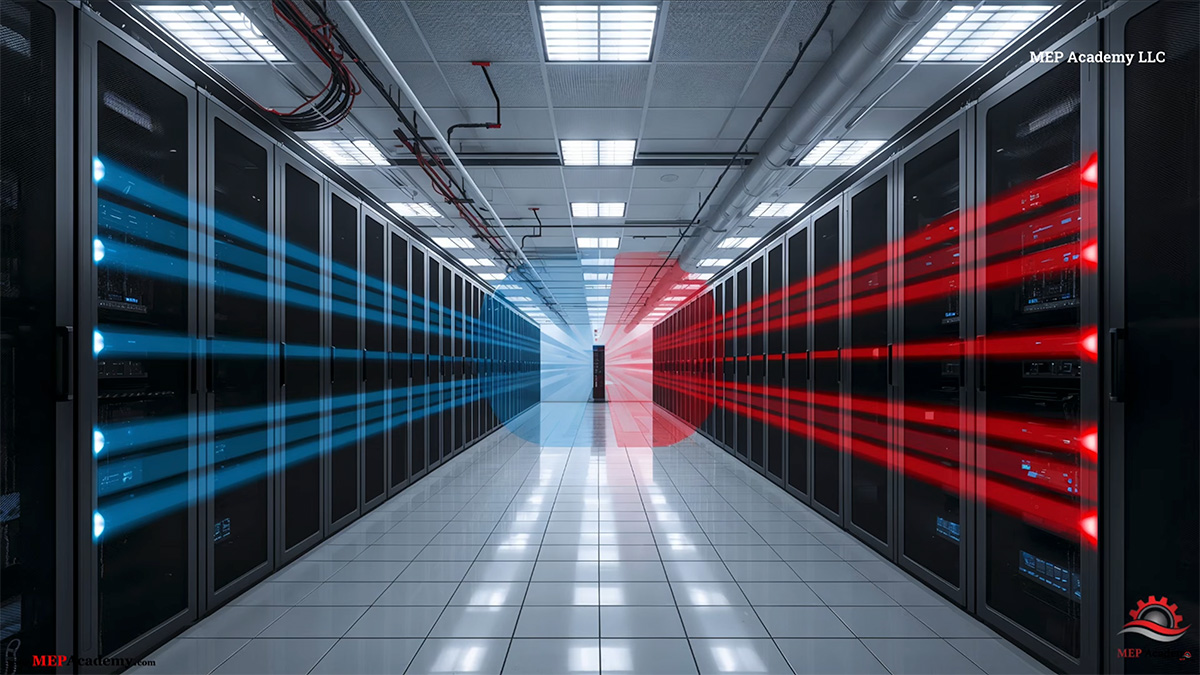
MEP Academy’s recent video in its data center series takes on one of the most practical topics in facility design: hot aisle versus cold aisle containment, why the distinction matters, and how physical enclosure changes the efficiency equation. It’s a clean, well-paced explainer aimed at engineers who want a solid conceptual foundation before getting into specifics.
The video walks through the progression from basic rack orientation to full containment. A cold aisle arrangement—racks facing each other at the front—gets cold supply air to server intakes but does nothing to stop exhaust air from recirculating overhead. Hot aisle orientation flips that logic, concentrating exhaust in a dedicated corridor pointed back toward return air. Both layouts help, but without physical enclosure, mixing still happens and the cooling system compensates by working harder than it should.
Containment is where the real efficiency gains appear. Cold aisle containment encloses the supply side, locking in consistent inlet temperatures and making it a relatively straightforward retrofit. The tradeoff: the rest of the room runs warmer, and at higher rack densities the approach starts to break down. Hot aisle containment does the opposite—it captures exhaust at the source and routes it directly back to cooling equipment, keeping the general room environment cooler and giving the cooling system cleaner, hotter return air to work with. The video correctly identifies hot aisle containment as the preferred strategy for high-density deployments, where return air temperature control has a direct, measurable impact on cooling system efficiency and equipment lifespan.
One point the video makes that’s worth carrying into design conversations: the choice between containment strategies isn’t just a mechanical decision. Hot aisle containment requires early coordination with fire suppression engineers, since enclosing a hot corridor introduces complications for suppression system coverage and air movement during a discharge event. Retrofitting containment into an existing facility without that coordination is a common source of compliance headaches. The video doesn’t go deep on that angle, but it flags it clearly enough to prompt the right questions before a project gets too far along.
MEP Academy publishes consistently structured educational content for mechanical, electrical, and plumbing engineers, and this entry holds up well as a reference for anyone onboarding into data center work or preparing for a facility audit.
Source: MEP Academy