
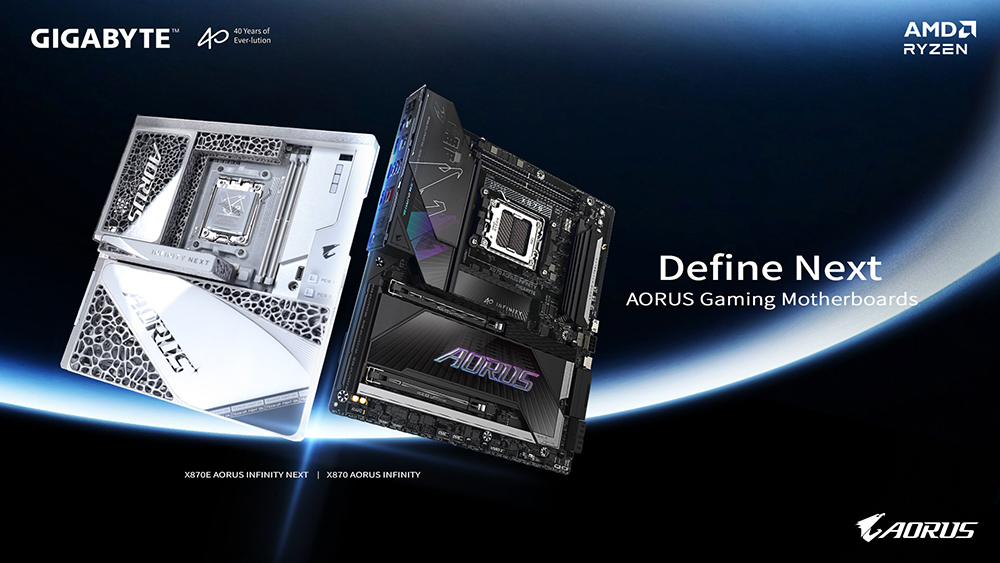
GIGABYTE introduced its 40th anniversary X870E and X870 AORUS INFINITY series motherboards at COMPUTEX 2026, targeting AMD’s Ryzen 9950X3D2 processors and adding an AI-enhanced overclocking feature called X3D Turbo Mode 2.0. The company also lists memory support up to 11,400 MT/s across the series.
The lineup includes the X870E AORUS INFINITY NEXT and the X870 AORUS INFINITY. GIGABYTE describes X3D Turbo Mode 2.0 as an “AI-enhanced overclocking” approach: the boards include an onboard hardware chip that monitors operating conditions and workload behavior in real time, paired with a dynamic OC engine that the company says is trained on “big data” to optimize performance per processor.
On the cooling and power side, the X870E AORUS INFINITY NEXT centers on a 3D metal-printed “AI Gyroid M.2 heatsink structure.” GIGABYTE says the 3D-printed structure increases cooling surface area by up to 44%. The design also includes a 3D-printed vapor chamber and a honeycomb-structured metal backplate. For VRM, the board is specified with 64 power phases and “Quad OptiMOS” components, with GIGABYTE listing up to 5,120 amps of total current capacity.
The X870 AORUS INFINITY focuses on memory latency and responsiveness. GIGABYTE states the board “pushes CL24 timing,” which it calls “twice as tight as standard timings,” and claims a 20% “speed advantage” along with “the lowest memory latency ever on the AMD X870 platform.” Those are big performance assertions, but for engineers the practical takeaway is simpler: if the platform can actually hold CL24 stable at the target data rates, it’s squarely aimed at shaving memory access time rather than just chasing peak bandwidth numbers.
GIGABYTE has a product page for more details on the X870E and X870 AORUS INFINITY series.
Source: GIGABYTE