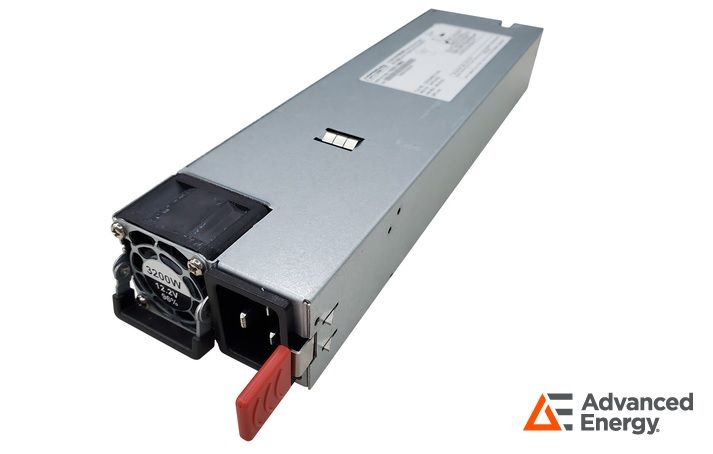

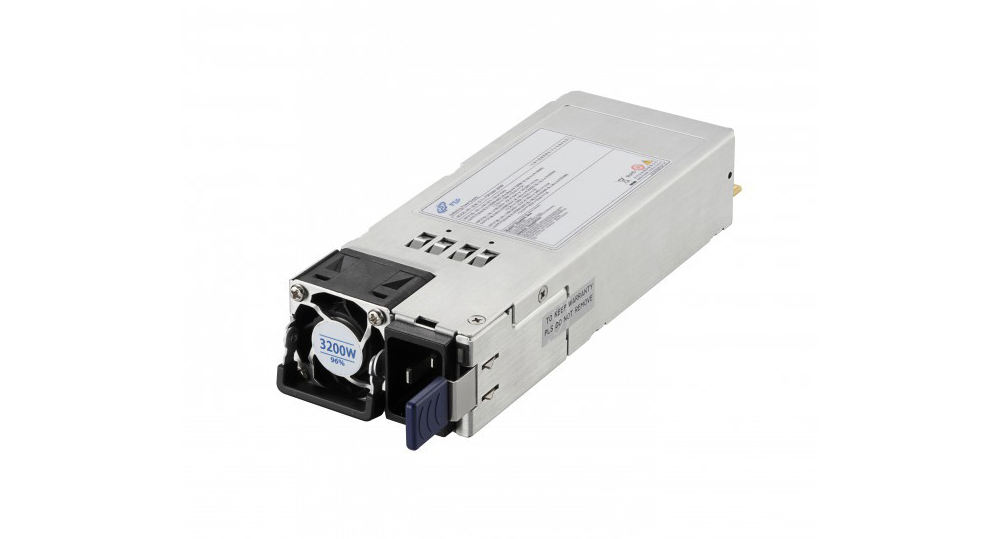
FSP Group has introduced two 3,200 W Common Redundant Power Supply (CRPS) modules aimed at edge AI servers and next-generation data centers: the FSP3200-20HM with a 12 V output and the FSP3200-21HE with a 54 V output. Both units are 80 PLUS Titanium certified and built around what FSP calls EDPP (Electrical Design Power Peaks), a feature intended to handle short-duration transient surges above rated power.
The company is pitching the dual-voltage approach as a way to cover both existing 12 V server designs and newer high-voltage DC architectures. In a typical retrofit scenario, the 12 V FSP3200-20HM is intended for enterprise data centers, storage arrays, workstations, and edge compute nodes where operators want to increase compute density without reworking the server power architecture.
The 54 V FSP3200-21HE targets multi-GPU systems and higher-density AI server designs. FSP points to a basic electrical advantage of a higher-voltage distribution bus at the same power level: lower current, which reduces I²R losses in distribution paths such as busbars and interconnects. For data center engineers, that matters most when you’re chasing marginal efficiency gains under sustained high load, and when conductor heating starts stealing thermal headroom from already tight GPU inlet targets.
Both 3,200 W CRPS modules support PMBus for digital telemetry and monitoring, including real-time voltage, current, temperature, and power consumption. They also include protection functions listed as over-current protection (OCP), over-voltage protection (OVP), over-temperature protection (OTP), and output short-circuit protection. FSP also cites “exceptional MTBF” for 24/7 operation, but doesn’t quantify it.
EDPP is the most practical differentiator called out here. The idea is straightforward: instead of oversizing a PSU’s continuous rating just to survive short, sharp GPU load spikes, the power supply is designed to deliver brief peak power above its nameplate rating. FSP ties EDPP to its “full-digital power control technology,” with the goal of improving transient response during GPU-driven load steps while balancing power density, efficiency, bill-of-materials cost, and dynamic workload behavior.
FSP also said it plans to expand its high-density CRPS roadmap, with higher-wattage CRPS solutions scheduled for release in the second half of this year.
Source: FSP