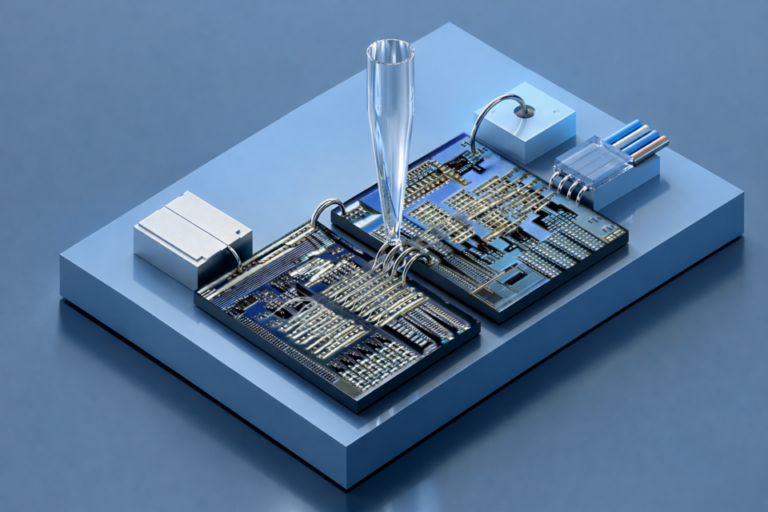

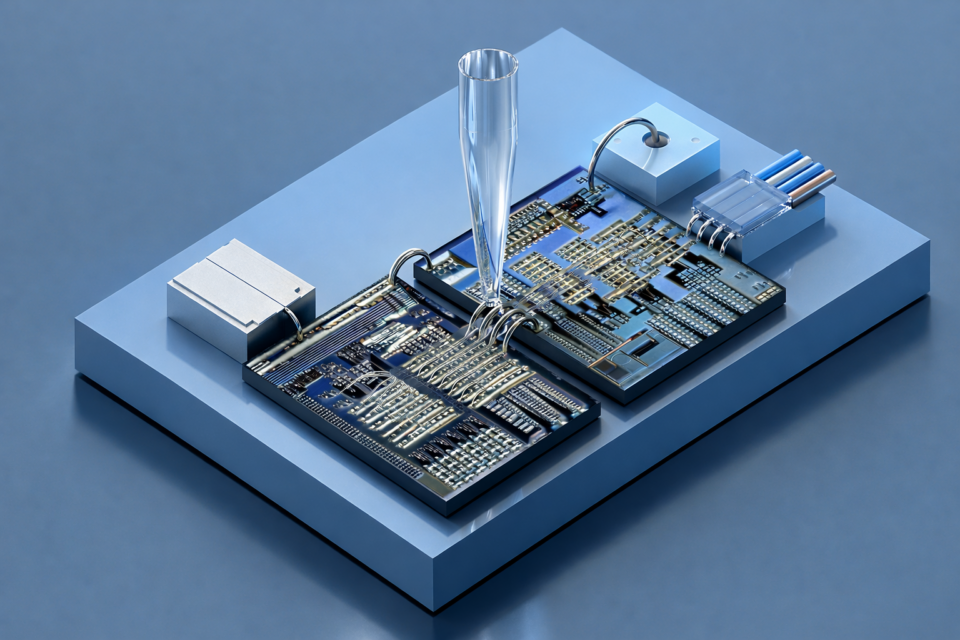
Lessengers has introduced a 3.2T glass-substrate near-packaged optics (NPO) platform built around its direct optical wiring (DOW) technology, targeting higher optical interconnect density inside network switch chassis for AI and HPC fabrics.
The architecture is rated at 3.2 Tbps per optical engine and is designed to move optics closer to the host ASIC, with the optical core positioned “mere millimeters” from the ASIC to reduce reliance on front-panel pluggable modules. Lessengers says the approach bypasses traditional packaging limitations to increase bandwidth density and improve power efficiency.
At the packaging level, the platform uses a glass core with vertical through-glass vias (TGVs), moving away from organic substrates. Lessengers points to glass’s low coefficient of thermal expansion (CTE) as a mechanical match for silicon, aiming to limit warping and micro-shifting under workload-driven thermal swings—an issue that can complicate high-speed optical coupling and assembly tolerances.
On the optical path, Lessengers describes integrated planar waveguides inside the glass substrate and “DOW-based polymer waveguides” to route light through the substrate layer. The company characterizes the result as “near-lossless signal integrity at ultra-high frequencies,” a claim operators will want to validate with link budgets and system-level BER data once designs are in evaluation hardware.
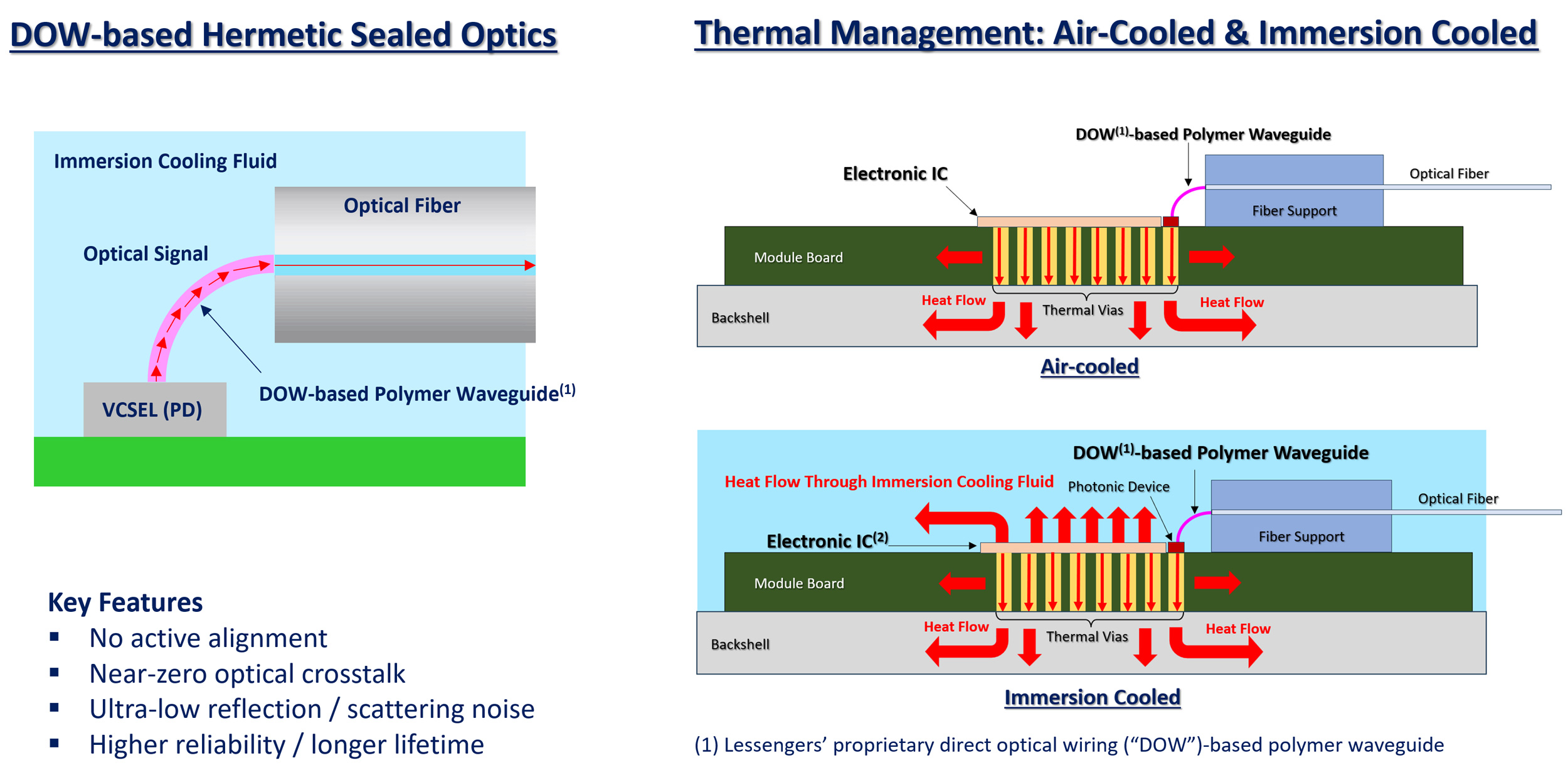
Lessengers also says DOW avoids active alignment and multi-channel lens assemblies, with the goal of reducing manufacturing complexity. For data center operators, that matters less as a headline feature than as a potential reliability and cost variable: fewer precision alignment steps can translate into better manufacturability and more consistent module-to-module performance, if yields hold up in volume.
For liquid-cooled deployments, Lessengers says DOW forms a hermetic seal around active optical junctions, making the 3.2T NPO module “immersion-cooling native” without additional packaging. That’s a concrete design target as immersion expands beyond niche deployments, because optics packaging often becomes a gating item when the entire rack environment changes.
Lessengers ties the 3.2 Tbps engine density to switch scaling, saying it enables switch manufacturers to deploy 51.2T and 102.4T-class networking hardware.
“The binding constraint in AI infrastructure is no longer just compute power—it is the energy and signal loss born by moving data between chips,” said Chongcook Kim, CEO of Lessengers. “By merging the superior mechanical and optical properties of glass substrates with our DOW, we have crafted a scalable 3.2T platform that changes the physics of data center networking, offering an open, socketable ecosystem that drastically slashes power and assembly complexity.”
Lessengers plans to show live demonstrations of its DOW ecosystem and related architectures, and is directing engineering inquiries to its website.
Source: Lessengers