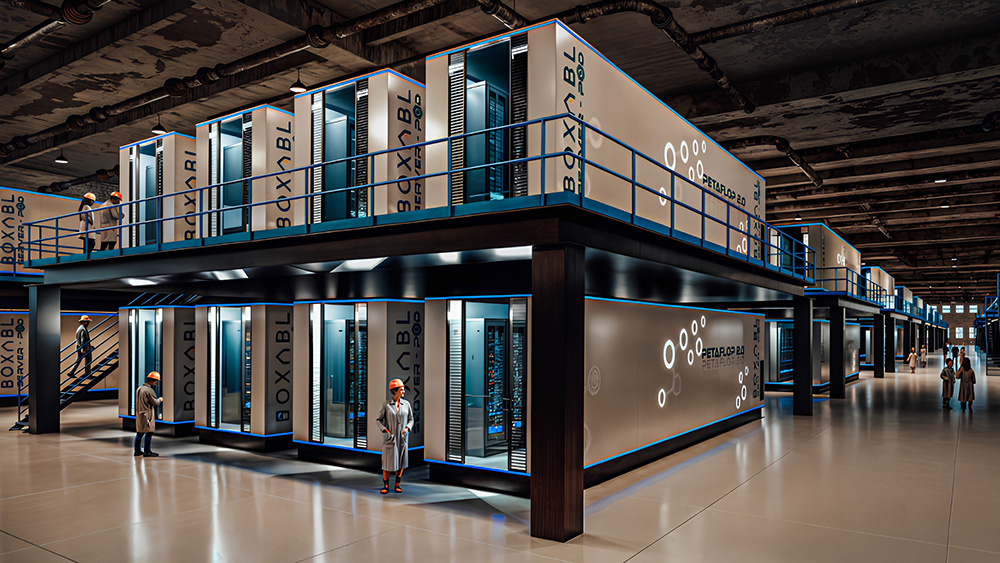
BOXABL has published a “Server Pod” design concept for factory-assembled enclosures intended to house AI and cloud computing infrastructure. The company emphasized that Server Pods are not in production and are not for sale; the concept is intended to spark conversations with data center developers, operators, and equipment vendors about custom-designed, factory-built structures.
BOXABL framed the concept against projections from JLL Research that data center investment could reach up to $3 trillion by 2030. BOXABL also pointed to JLL’s view that the market is expected to grow at a 14% CAGR through 2030, with roughly 100 GW of new capacity coming online between 2026 and 2030, nearly doubling global capacity. JLL also reported that data center construction costs have risen at a 7% CAGR since 2020, and that “speed to power” is now the top site-selection criterion, with grid connection wait times exceeding four years in many primary markets.
The design study outlines several conceptual configurations. A 10-foot Server Pod concept envisions a 0.5 petaflop tier with eight racks (7′, 42U), “up to 250 servers,” and “15 cores,” inside a 10′ x 8.5′ insulated envelope with 9′ ceilings. A 20-foot concept targets a 1.0 petaflop tier with 16 racks (7′, 42U), “up to 500 servers,” and “30 cores,” in a 20′ x 8.5′ envelope. A 40-foot concept envisions a 2.0 petaflop format with 36 racks (7′, 42U), “up to 900 servers,” and “56 cores.” BOXABL also described “Server Tron,” a 2,500-square-foot concept aimed at enterprise-scale deployments and envisioned at 16 petaflop operations per second.
As drawn, each unit would combine filtered-air and liquid-cooled precision cooling with a “thermally broken” building envelope. The concept also calls for a pre-cabled, clean enclosure with pre-installed racks, built on a structural pallet frame with integrated fork pockets for positioning on site. But BOXABL noted that actual configurations, cooling approaches, and equipment would be determined per customer.
Conceptual engineering targets cited in the study include 2-inch exterior wall, floor-over-frame, and ceiling assemblies targeting an R-8 insulation value, a 50 psf floor live load, a 40 psf roof live load, and a 110 mph wind speed rating. BOXABL also described typical site work for a custom project as including validation of site conditions (wind, snow, seismic, and flood considerations), site preparation, utilities, anchoring, permitting, easements and setbacks, and electrical service connections.
“We are not selling Server Pods today—we are inviting companies to bring us their data center problems and partner to design and build a custom solution,” said Paolo Tiramani, Co-CEO of BOXABL.
Companies can register interest for custom projects at boxabl.com/ai-data-centers.
Source: BOXABL