

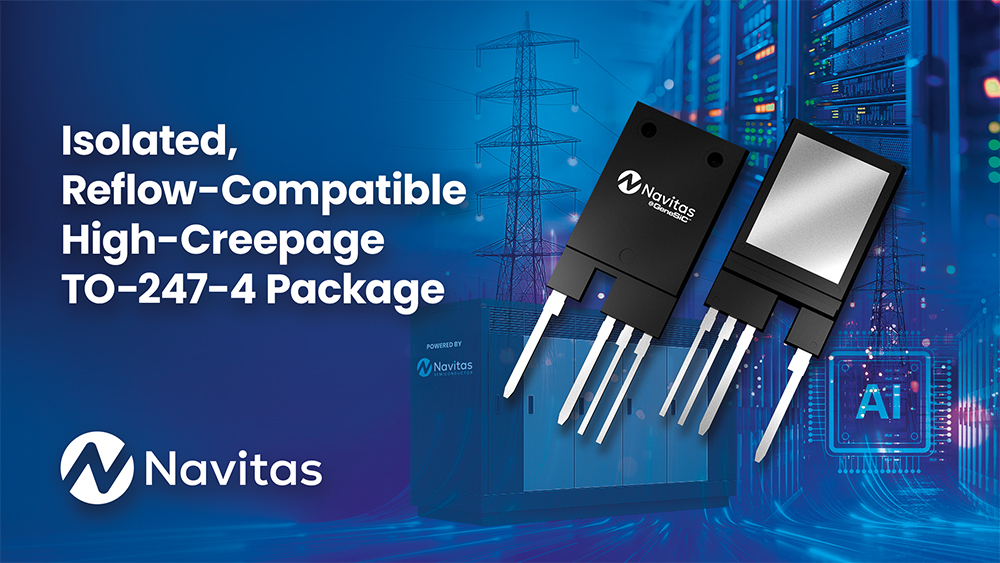
Navitas has launched a new isolated through-hole package for its GeneSiC silicon carbide MOSFETs aimed at high-voltage power conversion designs that need both creepage clearance and direct-cooling capability. The UHV-TO-247-4-ISO package targets 1200 V to 3300 V devices and is designed to mount directly to liquid- or air-cooled heat sinks via an integrated, reflow-compatible thermal pad.
The UHV-TO-247-4-ISO package features over 12 mm pin-to-pin creepage and greater than 6000 V of integrated isolation. Navitas ties that isolation to an aluminum nitride (AlN) substrate, with the goal of eliminating external high-voltage isolation materials in the mechanical stack and simplifying assembly.
On the thermal side, Navitas says the isolated thermal pad removes the need for external thermal interface material (TIM) between the package and the heat sink. The company claims that can reduce RTH,J-HS by up to 60% and enable up to 150% higher power dissipation capability versus standard non-isolated through-hole packages. Those are big deltas for designers trying to keep switching devices inside junction-temperature limits without moving to a full power module, but they’ll still hinge on the heat sink design, mounting pressure, and coolant or airflow conditions in the final system.
Navitas also points to lower die-to-heatsink stray capacitance compared with external ceramic-based isolators, which it says reduces common-mode noise and radiated EMI, enabling higher switching speeds and lowering system-level EMI mitigation cost. For high-frequency, high-voltage stages, that capacitance path to the heat sink can be a real headache, so integrating isolation in the package is a practical way to attack it.
The package is offered across 1200 V, 2300 V, and 3300 V SiC MOSFET ratings, with these listed parts and RDS(on) values: G5R06MT12UIK (1200 V, 6.5 mΩ), G5R12MT12UIK (1200 V, 12 mΩ), G4H11MT23UIK (2300 V, 11.5 mΩ), G4H23MT23UIK (2300 V, 23 mΩ), G4H22MT33UIK (3300 V, 22.5 mΩ), and G4H45MT33UIK (3300 V, 45 mΩ).
“High-power system design is fundamentally challenged by the need to balance efficient thermal management with robust high-voltage isolation,” said Paul Wheeler, VP and GM of the SiC Business Unit at Navitas. He added that the package is intended to enable “power module–class performance in a compact discrete form factor” and support applications including “immersion-cooled and liquid-cooled power electronics.”
Navitas says the UHV-TO-247-4-ISO footprint is compatible with the TO-247-4 form factor and lead geometry, aiming to simplify drop-in adoption for existing layouts.
Source: Navitas