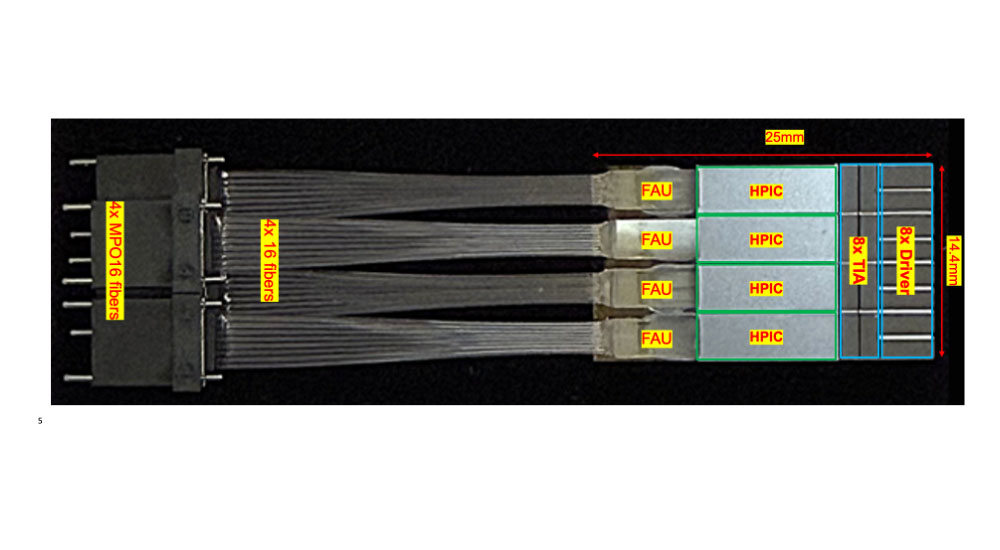
Skorpios Technologies announced its Tru-SiPh optical engine platform, including 1.6 Tbps and 6.4 Tbps optical engines aimed at 102.4 Tbps Ethernet switches for hyperscale AI data centers and GPU fabrics. The company positions the 1.6 Tbps photonic integrated circuit (PIC) and optical engine as a cost-per-bit and power reduction play for large-scale transceiver deployments starting in 2026.
On the density side, Skorpios says the Tru-SiPh 6.4 Tbps optical engine supports a 102.4 Tbps Ethernet switch architecture built from 16 × 6.4 Tbps DR32 Optical Sub-Assemblies, with each sub-assembly incorporating four 1.6 Tbps optical engines. The platform is described as Linear Pluggable Optics (LPO) at 200G per lane, with integrated driver and TIA electronics, silicon interposer integration for high-speed electrical routing, and flexible connector support (MPO, MMC, or SN-MT). Skorpios also claims approximately 30% lower power consumption versus “conventional optical architectures.”
A key architectural point in the announcement is serviceability. Skorpios says the 6.4 Tbps optical engine is built on an open, pluggable design that allows individual optical engines to be replaced without disrupting the rest of the 102.4 Tbps switching fabric. The company contrasts this with tightly integrated co-packaged optics approaches, where an optical failure can drive service actions at the switch platform level.
Thermals are another explicit target. Skorpios states its Tru-SiPh optical engines operate at temperatures up to 85°C without dedicated cooling. It also said it plans to introduce next-generation optical engines in Q3 2026 capable of 400G per lane and operation up to 120°C, while “maintaining up to 45-year laser reliability.” In the same announcement, Skorpios describes “high-reliability integrated and redundant lasers with projected lifetimes up to 45 years,” and characterizes the platform as integrating redundant lasers, amplifiers, modulators, and photodiodes directly into silicon.
“By integrating redundant lasers, amplifiers, modulators, and photodiodes directly into silicon using our Tru-SiPh platform, Skorpios is enabling the most compact and efficient 1.6T and 6.4T optical engines powering the optical backbone of next-generation AI infrastructure,” said Gunter Reiss, Chief Revenue Officer of Skorpios Technologies.
Skorpios CTO Damien Lambert took direct aim at external-laser pluggable approaches: “Our Tru-SiPh platform integrates both primary and backup lasers directly into the Photonic Integrated Circuit (PIC) with real-time monitoring and seamless failover, delivering up to 45 years of time to 0.25% cumulative failure at maximum temperature.” He also said the platform is “compatible with Broadcom Tomahawk 6,” and the PR lists compatibility with “Broadcom TH6 and next-generation networking ASICs.”
Commercially, Skorpios said its Tru-SiPh-powered 1.6 Tbps and 6.4 Tbps optical engines will begin sampling to customers and ecosystem partners later in Q2 2026.
Source: Skorpios Technologies