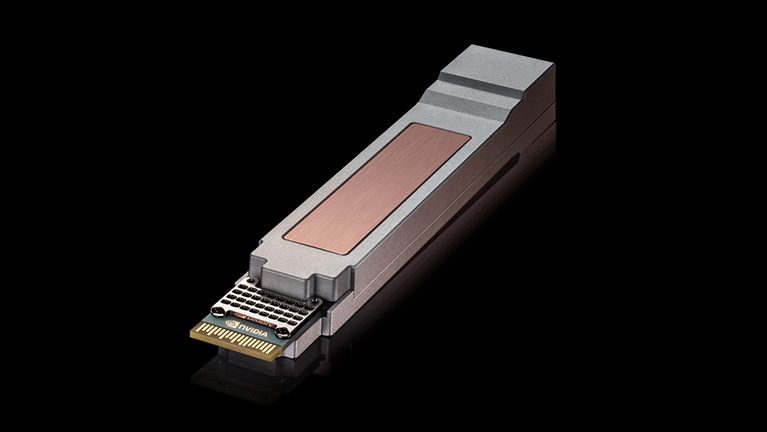

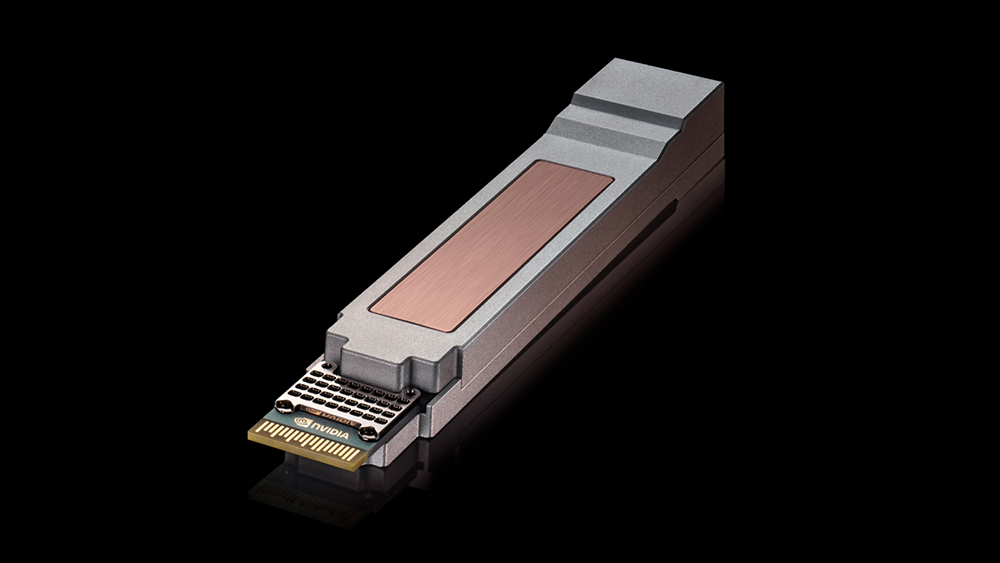
NVIDIA and Cisco introduced Ultra-Dense Small Form Factor Pluggable (USFP), a new pluggable optics form factor aimed at scaling 400 Gb/s-per-lane Ethernet AI fabrics while keeping the same network footprint. The companies are also working with TE Connectivity and Amphenol on a multi-source hardware ecosystem around the form factor.
USFP is designed for 400 Gb/s-per-lane electrical signals and targets total module capacity up to 12.8 Tb/s. The first planned USFP-based transceivers pack 16 full-duplex lanes in an OSFP-sized footprint, with the ability to expand to 32 or more lanes in the future. NVIDIA and Cisco say doubling both lane count and bandwidth per lane is intended to connect more 1.6 Tb/s endpoints without adding network tiers.
Compared with 200 Gb/s-per-lane pluggable modules, USFP delivers 4x the bandwidth and front-panel bandwidth density, with approximately 1.3x the power efficiency. That combination is directly relevant to AI clusters where scaling often hits two hard limits at once: front-panel real estate and a networking power budget that grows fast when fabrics sprawl into additional tiers.
On the mechanical and electrical side, USFP uses a two-dimensional array connector with a two-step insertion design that engages high-speed contacts after the module is inserted. NVIDIA and Cisco describe that approach as reducing contact wear, improving signal integrity, and making insertion force more predictable. The connector is designed for 400 Gb/s performance, and the companies say it can also improve performance at 200 Gb/s per lane.
Thermally, USFP supports power dissipation up to 100 W without requiring a separate embedded cooling circuit inside the transceiver, which NVIDIA and Cisco say reduces switch design complexity and improves reliability. USFP configurations also support optical designs intended to reduce latency and power consumption by simplifying signal processing, and the form factor is meant to support a broad range of optical technologies and connection distances.
“Building the world’s largest AI factories starts with rethinking the smallest of connections,” said Gilad Shainer, senior vice president at NVIDIA. “With USFP, NVIDIA and Cisco are building an ecosystem to reinvent pluggable optics—connecting more computing with greater efficiency to power the next generation of AI factories.”
Cisco senior vice president and general manager of optical systems and optics Bill Gartner said the companies designed USFP to deliver higher bandwidth density while “preserving the serviceability, deployment flexibility and operational simplicity of pluggable optics,” adding that the collaboration takes a “full-stack approach—from silicon and systems to optics and the network operating system.”
NVIDIA and Cisco said they plan to create an open industry specification for USFP through an upcoming community-led multi-source project.
Source: NVIDIA