
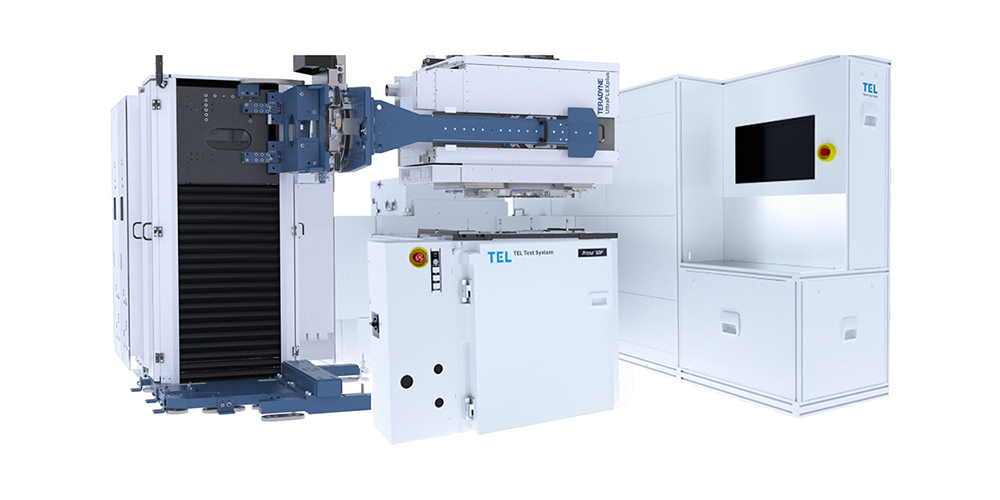
Teradyne has introduced an integrated test cell aimed at known good device (KGD) screening for AI and data center devices, developed in collaboration with Tokyo Electron. The setup pairs the Teradyne UltraFLEXplus test platform with Tokyo Electron’s Prexa SDP (Singulated Device Prober) to support screening for advanced 2.5D and 3D packages.
The companies are targeting fabless designers, foundries, and OSATs that need device screening at multiple points in an advanced packaging flow. The combined system is intended for singulated device testing and is described as production-ready, with emphasis on thermal control, power density handling, and digital performance requirements associated with current AI and data center silicon.
KGD screening matters more as chiplet-based architectures push more value into a single package. With 2.5D and 3D assemblies integrating multiple die, one defective die can compromise the entire package, so screening earlier in the flow is a direct lever on yield protection and quality. For operators and hardware teams downstream, that can translate into fewer bad parts making it into expensive integration stages, where debug cycles and scrap get painful fast.
In the integrated cell, UltraFLEXplus instruments coordinate with the Prexa SDP prober, which maintains device temperature and manages high-power dissipation characteristics typical of leading-edge AI silicon. The solution is also described as built on an open ecosystem architecture, with flexibility across complementary probe cards, manipulators, and interface technologies, and the ability to integrate with other probers or testers as required.
“TEL’s industry-leading Prexa SDP, combined with Teradyne’s UltraFLEXplus, gives customers a production-ready solution that covers singulated device testing with the thermal precision, power density, and digital performance that today’s AI and data center devices require,” said Shannon Poulin, president of the Semiconductor Test Group at Teradyne.
Teradyne and Tokyo Electron said the integrated solution is commercially available.
Source: Teradyne