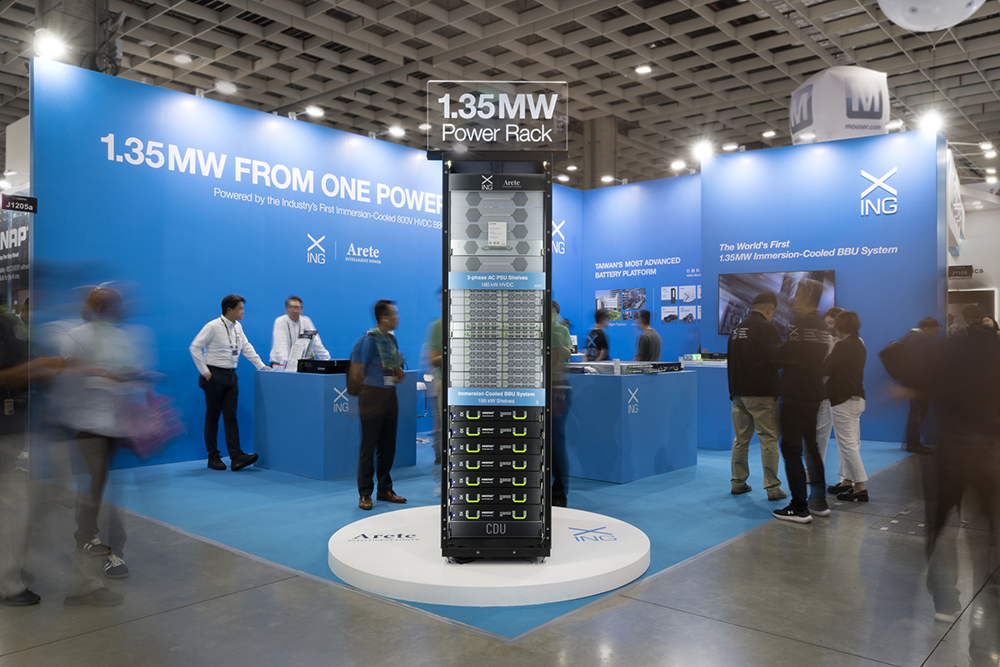
XING Mobility and Arete Intelligent Power have jointly developed a 1.35 MW HVDC power rack built around an 800 VDC platform, pairing an immersion-cooled backup battery unit (BBU) with a high-efficiency AC power supply unit (AC PSU) aimed at AI data center power-density requirements.
The system integrates XING Mobility’s IMMERSIO Matrix (Integrated Immersion Battery Architecture) BBU with Arete’s AC PSU in a single rack. XING Mobility is responsible for the immersion-cooled BBU and an in-rack coolant distribution unit (CDU), while Arete led the overall 800 V power rack design and its AC PSU.
On capacity, the rack is specified for 1.35 MW peak output with “full-load backup capability,” and is described as able to support up to two 660 kW or four 330 kW AI compute racks. The companies also specify end-to-end conversion efficiency of over 98% for the system.
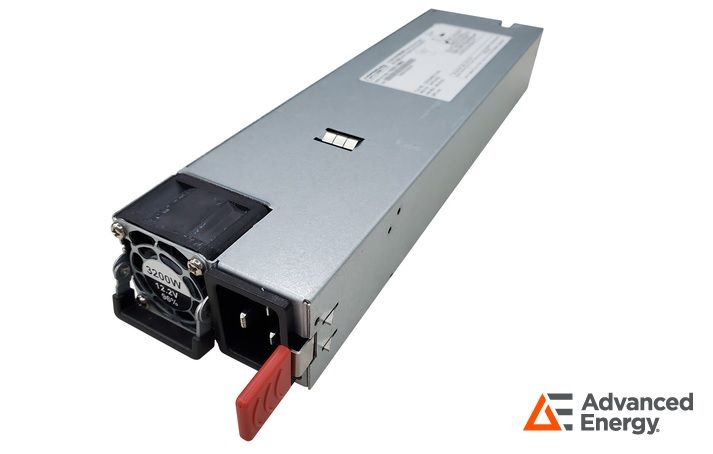
On the power conversion side, Arete’s AC PSU converts three-phase AC to 800 VDC with efficiency exceeding 98%, and supports ±400 V or 800 V output architectures. Arete also lists built-in grid-current smoothing targeted at the high-frequency dynamic load behavior associated with GPU workloads.
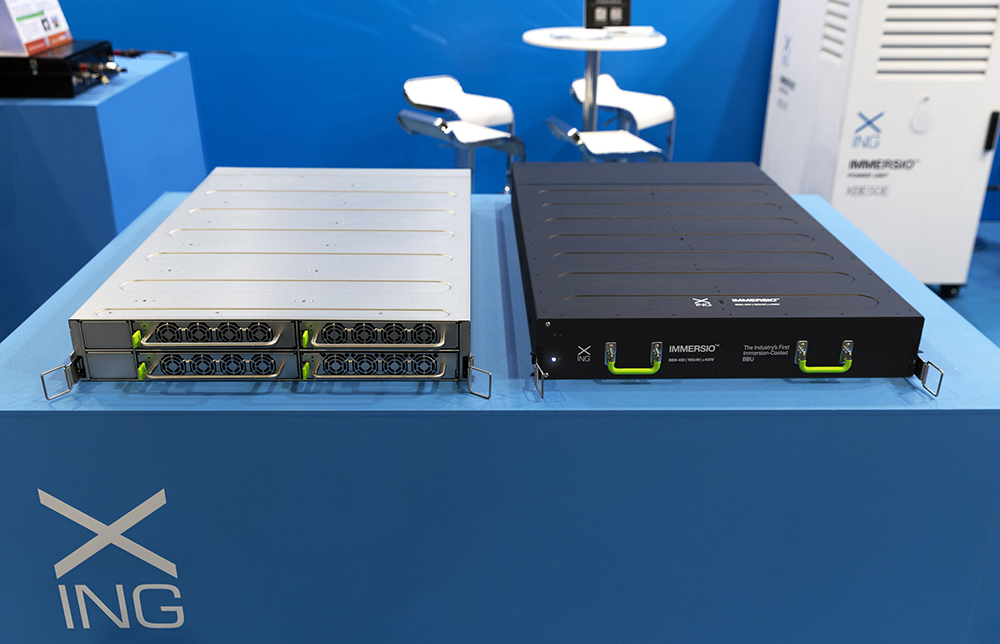
The BBU is built using XING Mobility’s IMMERSIO immersion architecture, which submerges components in dielectric coolant for direct thermal control. The BBU is specified for 1.35 MW peak backup output, and the company describes each 2 OU BBU module as sustaining 195 kW of continuous output. XING Mobility claims up to 2.5x the power density versus comparable solutions, and says cooling energy consumption is reduced to one-sixth of a fan-cooled system. In the described architecture, a single CDU manages heat dissipation for seven BBU shelves.
Megawatt-class power delivery changes the design constraints fast, and not just at the utility interface. Packing conversion, storage, and thermal management into a single rack at 800 VDC pushes engineers to think about fault domains, maintenance boundaries, and how cooling dependencies propagate during an event. Immersion-cooled BBUs also shift what “battery cooling” looks like inside the white space, because coolant distribution becomes part of the power system, not a separate facility service.
Royce Hong, founder and chairman of XING Mobility, said, “The explosive growth of AI computing is redefining what data center power infrastructure must deliver. Peak output, millisecond-level dynamic response, absolute reliability under extreme conditions, these are the standards we refined building supercar-grade battery systems.”
Source: XING Mobility