
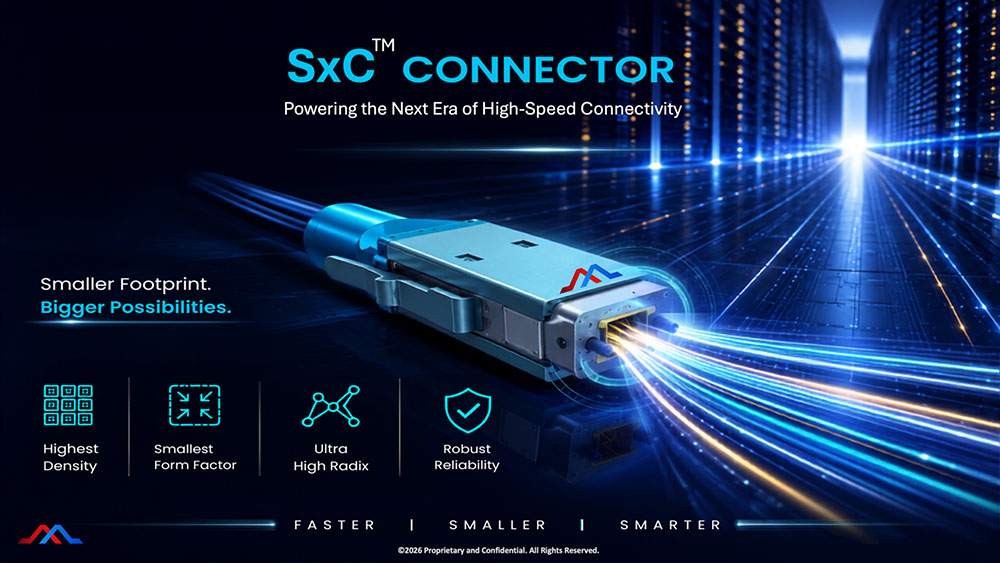
Mixx Technologies has introduced its SxC Connector, an expanded-beam optical connector designed to work both at the front panel and on an optical backplane for co-packaged optics (CPO) and near-package optical architectures. The company says the design can terminate up to 24,576 fibers in a single OCP rack unit, targeting high-radix scale-up networks where fiber I/O density at the box edge becomes a hard limit.
SxC scales to 64 fibers per connector and supports both single-mode fiber (SMF) and polarization-maintaining fiber (PMF) in the same form factor, depending on requirements. Mixx says the same connector can be mounted at a faceplate for front-plane use or seated in a bulkhead for backplane use, keeping one connector technology across the optical signal chain rather than mixing families inside and outside the chassis.
Density is the headline metric. By ganging 16 connectors within a bulkhead, Mixx says it can terminate 1,024 fibers in less than 800 mm². Using 24 bulkheads, the company says a single OCP rack unit reaches 24,576 fibers. Mixx compares that to MPO and VSFF connectors typically deployed at 16 fibers for this class of application, and it claims 4x the fiber density of MMC-VSFF, which it describes as the highest-density connector platform qualified for deployment today.
For data center engineers, the blunt takeaway is that co-packaged optics doesn’t help much if you can’t physically get enough fiber out of the box. As switch and optical engine integration pushes more optics inside the chassis, front-panel connector density and backplane interconnects become the practical constraints on radix, cabling complexity, and how many layers of switching a fabric needs.
Mixx says it is a member of the Expanded Beam Optics Multi-Source Agreement (EBO MSA), and that the first connector specification in that effort is now in development. The company also says its ferrule is glass (rather than plastic used in most connectors), which it says helps it handle optical power levels needed for remote-laser architectures and future multi-wavelength signals.
On manufacturing, Mixx says it forms optical structures in a wafer-scale integrated process (including free-form optics, 3D waveguides, and 2D fiber holes) to enable placing fiber in a two-dimensional array for higher density and low loss. Mixx also says it is automating cable assembly with robotic fiber assembly and automated visual inspection, and that the connector supports passive fiber attach to avoid the lens-to-fiber active-alignment step that has historically constrained yield and throughput.
“What Mixx has built is not a denser version of the last connector,” said Vivek Raghuraman, CEO of Mixx Technologies. “It is one ferrule technology that terminates the signal chain at the package, at the laser, at the backplane, and at the front panel, so the connectivity problem gets solved once instead of four times.”
Mixx Technologies said it will demonstrate the SxC Connector at SEMICON Taiwan starting September 2, 2026.
Source: Mixx Technologies