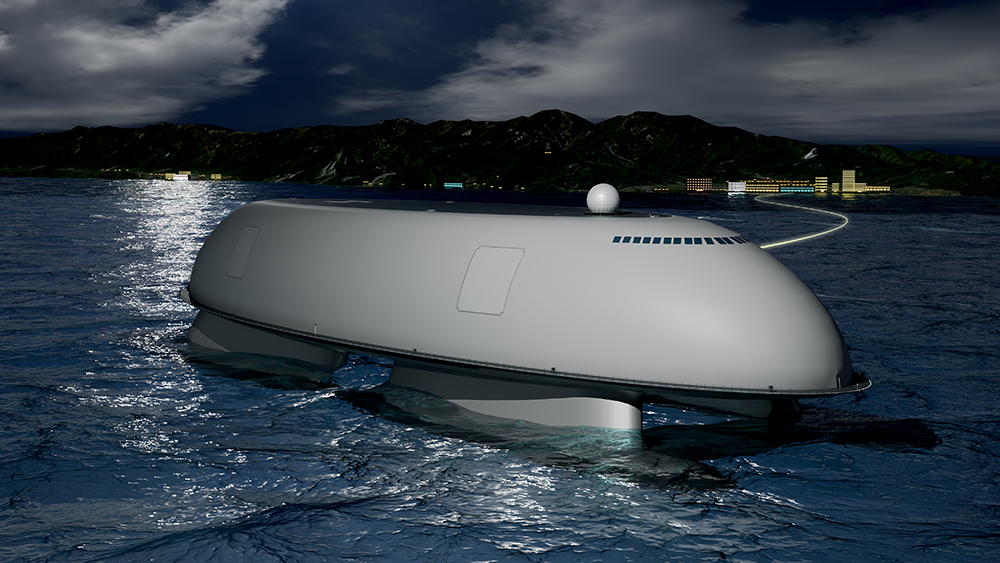
Optimal Transit, a maritime technology partnership of InMar Technologies and OptiFuel Systems, has unveiled a second configuration of its Kraaken platform: a proposed 100 MW SWATH vessel that would split output among shore power, desalination, and onboard AI compute.
The Blue Economy VITAL 100 MW concept uses the same small-waterplane-area twin-hull architecture, flexible mooring, and patented Digital Ocean Thermal (DOT) engine described in the company’s July announcement. Nothing in the announcement indicates a hull has been built, contracted, or classed. The company says it is still working toward ABS-ready drawings and digital-twin validation of the DOT engine.
In the VITAL allocation, Optimal Transit says the vessel would export up to 40 MW of continuous electricity to shore, produce about 30 million liters (7.9 million gallons) of fresh water per day via vacuum-flash desalination, and retain 60 MW for AI-grade compute. Power, water, and data would reach shore through a quick-disconnect umbilical so the vessel could unplug and relocate in hours.
For operators, the pitch is unusual: one offshore asset serving as both utility plant and data center, trading land, grid interconnect, and conventional permitting for marine operations, export hardware, and a mobility model closer to industrial shipping than a fixed facility. That remains a design claim, not a demonstrated system.
Jeff Kline, president of InMar Technologies, said: “The VITAL 100 MW configuration takes the same core capabilities and asks a different question: what happens when you point some of that output directly at a coastline that doesn’t have reliable power or clean water? The answer is a single vessel that can serve the equivalent of a small city—indefinitely, from offshore, with no connection to the existing grid.”
Optimal Transit puts all-in capital cost at about $587 million and compares that with $750 million to $1.33 billion for a land-based 40 MW plant, 7.9-million-gallon-per-day desalination plant, and 60 MW data-center shell. It estimates roughly three years to operation versus six to 10 years on land. Those figures and timelines are the company’s; no independent cost, schedule, or performance verification is public.
The company also describes a five-vessel “Sovereign Power Park” that it says would deliver about 200 MW of power, 40 million gallons of water per day, and 300 MW of compute
Source: Optimal Transit