
Power Integrations has published two auxiliary PSU reference designs aimed at 800 VDC AI data center power distribution, with form factors sized to fit tight layouts on main power distribution boards in NVIDIA’s Kyber liquid-cooled, blade-rack architecture.
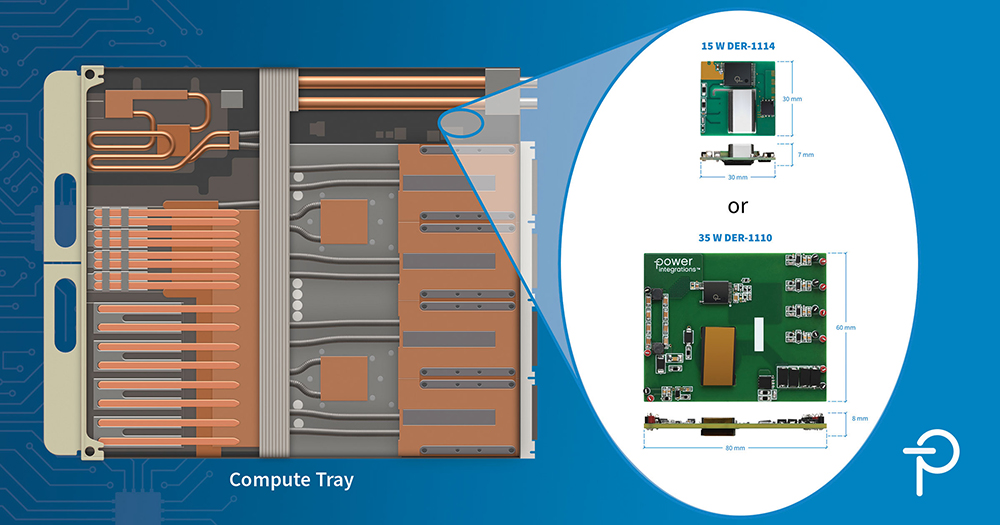
The two flyback designs are a single-output 15 W supply measuring 30 mm by 30 mm with a 7 mm profile, and an isolated six-rail 35 W supply measuring 80 mm by 60 mm with an 8 mm profile. Power Integrations puts both designs at at least 88% efficiency across line and load, and says the low-profile layouts can free up about 30% space on densely packed main PDBs, with an estimated 30% reduction in BOM count.
Both reference designs are based on Power Integrations’ InnoMux-2 ICs using 1700 V PowiGaN gallium-nitride technology. The company states that its 1700 V-rated InnoMux-2 IC supports 1000 VDC nominal input voltage in a flyback configuration. It also claims the IC can deliver “flat efficiency of 90 percent” in discontinuous conduction mode (DCM) while maximizing power delivery.
Auxiliary supplies like these are small compared to the main rack buswork, but they’re the part that keeps control electronics alive: Power Integrations calls out loads including MCUs, gate drivers, and op-amps used for system control and housekeeping. For operators and rack designers, the practical value is less about 15 W vs. 35 W, and more about board area, creepage/clearance constraints, and how many rails you can generate without turning an already-dense high-voltage PDB into a mechanical packaging problem.
Jason Yan, senior training manager at Power Integrations, said, “The only alternative solutions are discrete, costly silicon carbide (SiC) devices which require 30 percent more components and space to operate.”
The downloadable design documents are DER-1110 (35 W, multi-output, using the IMX2353F) and DER-1114 (15 W, single-output, also using the IMX2353F).
Source: Power Integrations