
Lightmatter and Global Unichip (GUC) have announced a strategic partnership to bring commercial Passage 3D Co-Packaged Optics (CPO) solutions to market for AI hyperscalers. The companies say the goal is to address connectivity bottlenecks that limit scaling for next-generation AI and high-performance computing workloads in large data centers.
The partnership combines Lightmatter’s Passage photonic interconnect with GUC’s ASIC design services and advanced packaging expertise. According to the companies, the joint solution is intended to improve chip-to-chip communications for XPU and switch silicon, with a focus on bandwidth density and power efficiency.
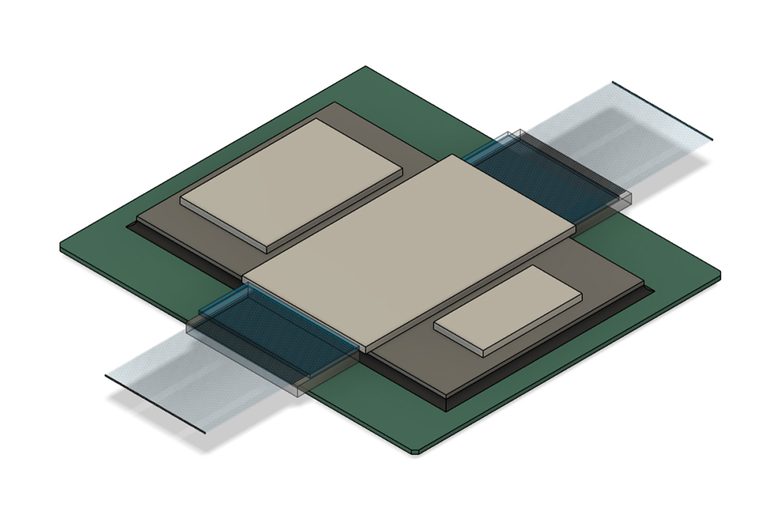
Lightmatter says Passage is a silicon photonics-based platform and describes it as a 3D-stacked silicon photonics engine. The companies also point to physical input-output limits, described as the chip “shoreline,” as a constraint on maximum bandwidth and radix per optical engine. They say the integrated approach is designed to extend the scale-up domain of AI clusters across multiple racks, improving training time and token throughput for large foundation models.
“Integrating Lightmatter’s Passage CPO platform into our world-class ASIC designs allows us to bring to market a joint solution that fundamentally redefines AI interconnect,” said Igor Elkanovich, CTO of GUC. “Our combined expertise solves complex challenges—architectural, thermal, mechanical, and signal integrity, and ensures that customers receive a robust, power-efficient, and scalable CPO platform that accelerates their path to large-scale AI deployment.”
In the same announcement, Industrial Technology Research Institute (ITRI) cited optical interconnect as a requirement for continued hyperscale AI growth. “The combination of GUC’s extensive experience in custom AI silicon design for top-tier cloud providers and Lightmatter’s innovation signals to the market that the supply chain is maturing, providing a credible blueprint for hyperscalers to address the critical bandwidth and power constraints of the next generation of AI clusters,” said Dr. Wei-Chung Lo, Deputy General Director at Electronic & Optoelectronic System Research Laboratories (EOSL) of Industrial Technology Research Institute (ITRI), Taiwan.
Source: Lightmatter