
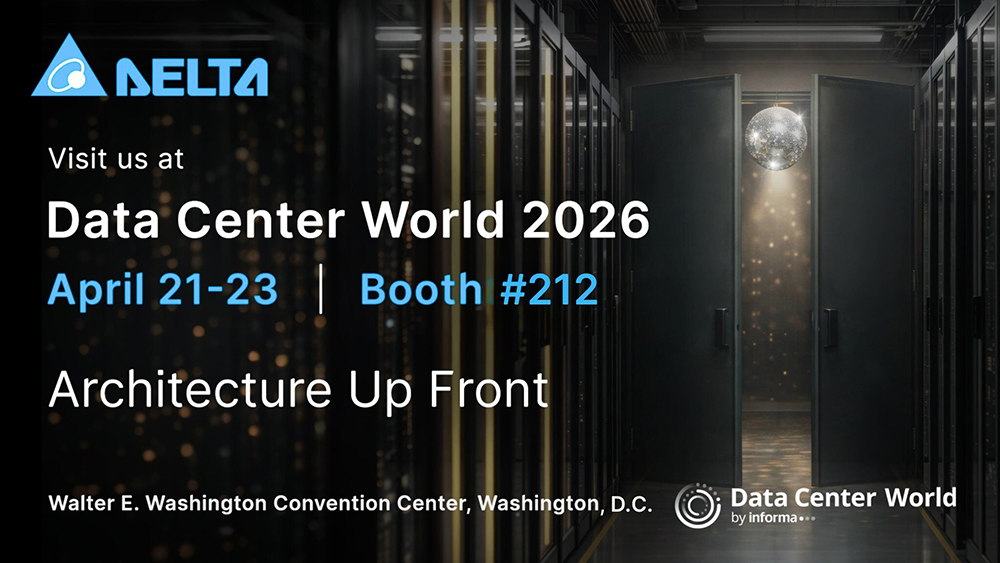
Delta used Data Center World 2026 to lay out what it calls a “grid-to-chip” architecture that combines power, cooling, and controls for AI data centers and other high-density compute environments. The company’s pitch is a single, scalable platform spanning electrical infrastructure, thermal systems, and facility controls—an approach aimed at operators dealing with rising rack power and tighter thermal margins.
On the power side, Delta’s Ultron DPM Gen-2 series UPS is positioned as a core building block. The three-phase UPS line covers 250–2500 kVA and is offered in 415 V and 480 V configurations for hyperscale, enterprise, and colocation deployments. Delta lists up to 97.5% efficiency in double conversion mode using SiC technology, and a scalable design that can expand up to 20 MW with N+1 redundancy.
For energy storage, Delta highlighted its UZR3 Li-ion Battery Cabinet, which it describes as having a global footprint exceeding 3 GW. The cabinet is UL1973 certified, has passed UL9540A testing with zero fire propagation, and achieves UL9540 certification when integrated with the DPM Gen-2 UPS. Delta also introduced the UZR3-S series, designed to meet NFPA 855 Large-Scale Fire Testing (LSFT) requirements, with “enhanced fire mitigation,” “optimized thermal management,” and “advanced system-level protection.” Fire compliance is where Li-ion conversations get real in data centers, so any cabinet claiming smoother alignment with stricter testing regimes is going to get close scrutiny from AHJs and risk teams.
On the cooling side, Delta plans to showcase a 3 MW liquid-to-liquid CDU rated for up to 3000 kW and up to 3000 LPM flow. The CDU includes dual power input and hot-swappable filtration, and it supports SNMP, Modbus TCP/IP, and BACnet for monitoring and integration.
Delta also described an 800 VDC architecture intended for “AI factory” environments. The company says its approach integrates high-density DC power shelves and rack-level power distribution to deliver up to 1.1 MW per rack at up to 98% efficiency, with high-efficiency DC/DC conversion, integrated eFuse protection, and a high-power busbar design. If those numbers hold in real deployments, it’s a direct attempt to cut conversion stages and simplify high-power distribution at the rack, where every efficiency point turns into heat you don’t have to remove.
For controls, Delta’s enteliWEB building management system is positioned as the operations layer across HVAC, electrical power systems, security, and lighting, with analytics and dashboards. The company also called out Red5 controllers, which can be built on environments such as Python and Node-RED, plus O3 AI-enhanced multi-sensors that monitor temperature, humidity, light, and sound.
Victor Lee, Senior Vice President of Data Center Strategic Business Platform at Delta, said, “By integrating power, cooling, and controls into a single architecture, we help customers eliminate complexity, improve efficiency, and scale confidently for the next generation of AI workloads.”
Source: Delta Electronics (Americas)