
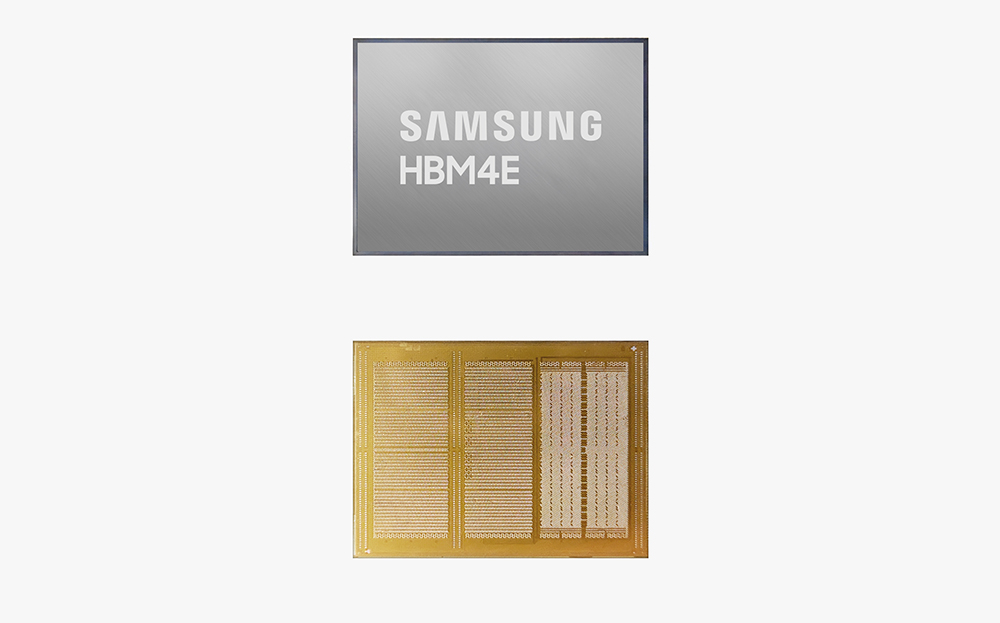
Samsung Electronics has started shipping HBM4E samples to what it describes as major global customers, putting a 12-layer high-bandwidth memory stack into customer hands for evaluation. For data center operators and AI infrastructure teams, HBM timelines matter because memory bandwidth, capacity per package, and power per bit increasingly set the ceiling on usable GPU performance for training and inference clusters.
The company’s HBM4E is specified at a stable pin speed of 14 Gbps, with performance scalable up to 16 Gbps. Samsung also lists up to 3.6 TB/s of memory bandwidth per stack and calls that more than a 20% increase over its HBM4. The initial 12-layer configuration is a 48 GB stack, which Samsung says is more than a 30% capacity increase over the previous generation. Samsung also plans 32 GB (8-layer) and 64 GB (16-layer) configurations “in accordance with customer requirements.”
On the process and packaging side, Samsung says HBM4E uses its sixth-generation 10 nm-class DRAM process (1c) and a Samsung Foundry 4 nm logic base die. It also points to “design and process optimization across both memory and logic architectures” to improve performance, power efficiency, and yield. Specifically, Samsung states energy efficiency improved by 16% and thermal resistance characteristics improved by more than 14% versus the previous generation.
Those thermal and efficiency deltas are the parts to watch in real deployments. Rack-scale power density keeps climbing, and HBM is packed close to hot silicon, so even modest improvements in watts per GB/s and junction-to-ambient thermal behavior can translate into higher sustained clocks or less aggressive cooling requirements at the node level. But sample shipments aren’t volume availability, and qualification cycles can stretch depending on the accelerator platform, package design, and system-level cooling approach.
Samsung said it will begin mass production of HBM4E aligned with customer schedules following sample shipments and optimization. Sang Joon Hwang, executive vice president and head of memory development at Samsung Electronics, said, “Through our advanced manufacturing capabilities and preemptive infrastructure investments, we will continue to drive the growth of the global AI memory market.”
Source: Samsung Newsroom